

The Executive Director for the Centre for Democracy and Economic Development Initiatives (CDEDI), Mr. Sylvester Namiwa, has said some senior members of the Malawi Congress Party as well as Government Officials and Minister are beneficiaries of the Forex trade that’s taking place on the black market in the country.
Namiwa’s statements, if true, implicates some cabinet ministers, government officials, and banks.
Speaking at a press briefing in Lilongwe yesterday (20th February), Namiwa says that certain high placed individuals are soliciting Forex in dollars from Malawian banks, and are using it to profiteer at inflated prices, despite the country having a severe Forex shortage, and despite the business community struggling because of the shortages.
“According to the findings, this trend is to blame for the further weakening of the local unit against the US dollar, since the latter is being traded without any backing,” Namiwa said. Reading a prepared statement, he went on to say that:
“...After the cancellation of the pre-loaded visa cards, that were subjected to abuse, commercial banks have put their foot down and are not selling the much sought-after US dollar, currently pegged at K1,751.00 on the official market.“
Namiwa says he has names of the people who are involved in these illicit transactions, some of whom are officials who request funds on the pretext of travel for official government business, but when they receive the Forex, they sell it at inflated black market rates. He gave an example of how a senior cabinet minister applied for US$450,000 from one of the commercial banks in Malawi, and once he received the funds, subsequently sold the Forex to an Asian Malawian businessman at an exchange rate of K4,200.
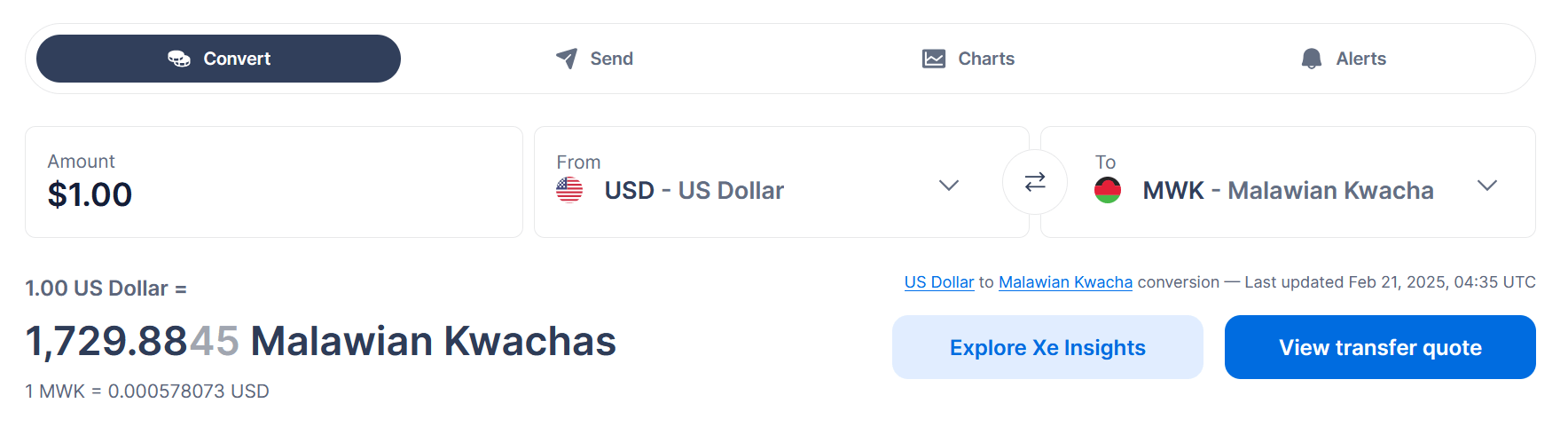
The exchange rate online is around K1,730 to the dollar as of 21st February 2025.
Namiwa also said details had emerged that some powerful individuals were getting the Forex directly from the Reserve Bank of Malawi.
He further said the Exchange Control Act was discouraging people in the diaspora from channeling their ‘hard earned’ savings through Foreign Currency Denominated Accounts (FCDAs) since that risks automatic conversion of these inflows into local currency.
Despite claiming to have evidence on all this, Namiwa remains shtum on the names of the people and banks which are involved in this illegal profiteering, claiming that the mandated state bodies who deal with such complaints like the Anti-Corruption Bureau (ACB) and the Finance Intelligence Authority(FIA) “have been captured” by the same individuals involved in the same illicit Forex trade. He says he expects Malawians to come forward and name the names.
The full press briefing can be watched below on YouTube via Malawian Cameras (channel not affiliated to us)
Malawi has been struggling with Forex shortages for a while now.
According to Namiwa, the way to tackle this problem is through “an initiative dubbed The People Power Forum’ where the citizenry will have a chance to ‘nominate’ public officers whose lifestyle, wealth and property is not commensurate with their legitimate earnings. Thus far, CDEDI has engaged a reputable international institution to manage the ‘nomination ‘ in a manner that does not give room for manipulation.”
Namiwa said the process will receive tip offs from anonymous sources regarding the executive (Cabinet ministers), political appointees (Political Advisers, employees of State Residences), members of the legislature (MPs), the Judiciary (Judges, Magistrates and Lawyers) and Civil Servants.
He said the way it would work in practice is that a free and dedicated whistleblower telephone line would be established where citizens can call to report figures or submit names of officials that they suspect are part of this cartel and involved in this illicit Forex trade, and if their lifestyles do not align with their earnings. Namiwa said that every two weeks, a naming and shaming exercise would take place.
It appears that such a whistleblower telephone line would then trigger an investigation to ensure that such people are not beneficiaries of theft, corruption and illicit proceeds. But it is not clear who will undertake such an investigation, since according to Namiwa, CDEDI is of the view that the ACB and FIA are ineffective or compromised.
“…We have entertained these cartels for unnecessary too long…it’s high time we need to rise up and act, if we don’t rise up we are finished” said Namiwa
He called on Malawians in Malawi and across the diaspora to support the initiative, and hold the officials and banks accountable.
 malawiace.com