
I watched the video below of the Billionaire Entrepreneur Sir James Dyson talking about his new ‘tech-heavy’ farm a few days ago, and it reminded me of an article I had started writing months ago, on vertical Farming. It’s been sat on my computer for months because i didn’t think it was ready to be published, and couldn’t find time to complete it. I have now condensed it and edited it, and below the video is a copy.
// ~ ~ ~ ~ ~ ~ ~//
Africa faces significant challenges in achieving food security due to rapid population growth, climate change, and limited arable land. Wars and political conflict also exacerbate the situation, with regions that have had long periods of wars disrupting people’s lives – who fleeing from wars, are unable to grow crops or rear animals.
Vertical Agriculture (a.k.a Vertical Farming) can offer a unique and transformative solution to some of Africa’s food challenges by maximising land use, conserving resources, and aligning with international development goals.
Now, years ago, I had this idea that maybe vertical agriculture in the UK, specifically when deployed to what are known as “allotments”, should resemble something like the AI generated images below:

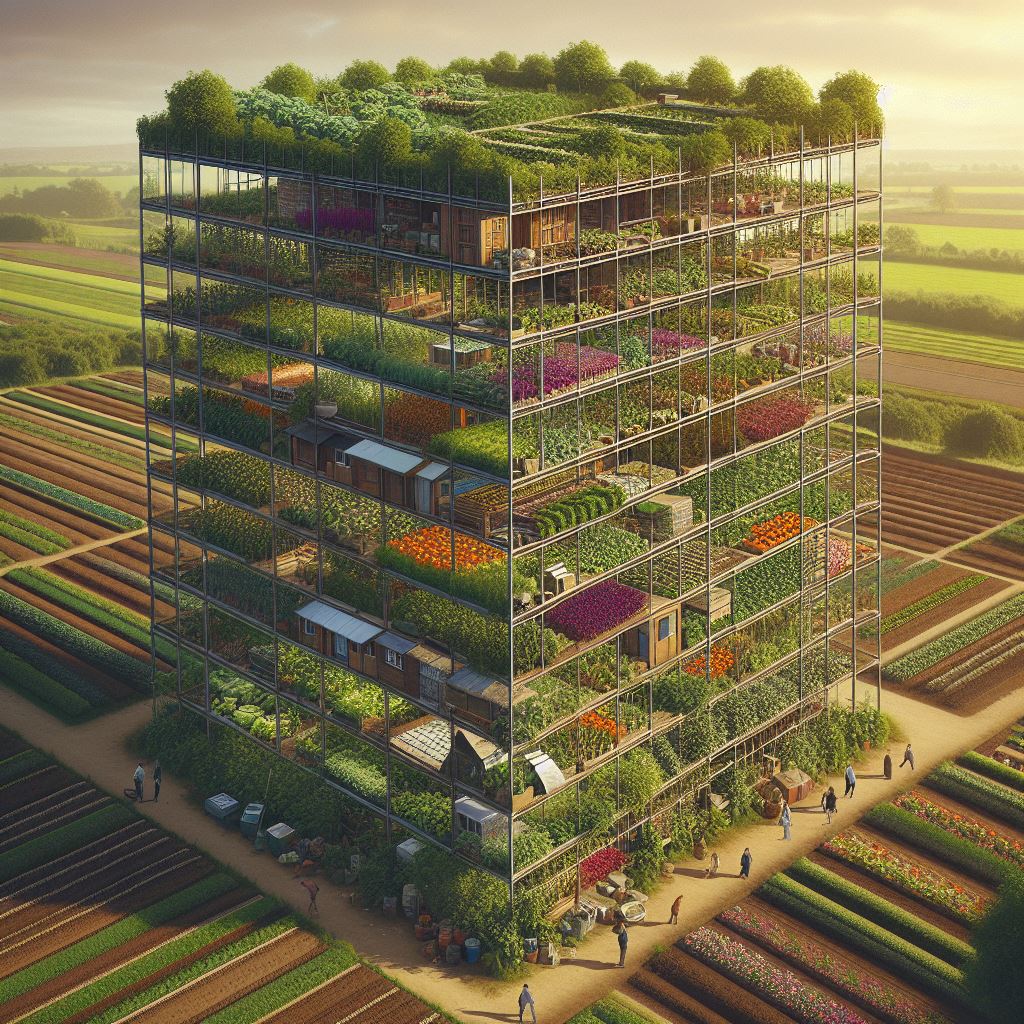


Although providing quite a lot of surface area for raised beds in which to grow plants, these structures would have come with some significant engineering challenges, not least the load-bearing capacity. I have since revised my ideas and think anything more than 3 or 4 floors is a bit too ambitious, for an outdoor structure that’s not fully sheltered. And would be too expensive. What happens for example when it snows? … In other words, there are probably more practical ways of putting such an invention to practice, ones which wouldn’t involve very thick and re-enforced steel columns to support all that weight. Even in the absence of snow.
Anyway, there are many benefits of Vertical Farming over traditional farming, particularly in Africa’s challenging environments, but below are some of them.
Land Efficiency: Vertical Farming uses up to 99% less land by stacking crops vertically. This is important in Africa where desertification and land degradation affects over 65% of arable land. But essentially it means less habitat-loss to farms, which means preserving forests, wild plant and animal ecosystems.
- Forests can help prevent floods and droughts (European Environment Agency)
Water Conservation: Hydroponic or aeroponic systems use 70–90% less water than conventional farming, which solves the water scarcity problem in arid or semi-arid regions. The Dyson video above also mentions similar efficiencies.
Climate Resilience: Controlled environments shield crops from extreme weather, pests, and diseases, and can lead to consistent yields. In controlled environments, the health of the soil can also be more deliberately engineered, and you can experiment with different types of compost depending on the vegetable that’s to be grown.
Year-Round Production: Artificial lighting and climate control allow continuous crop production, reducing seasonal dependency. This can reduce or altogether eliminate food shortages. It can also mean jobs throughout the year, whereas in seasonal planting cycles in some parts of the world, subsistence farmers will have some months when they don’t have any regular paid work.
Reduced Transport Costs: Urban vertical farms minimise the distance between production and consumption. This can lower carbon footprints and food costs. Thus, depending on where the structures are erected, it means that certain foods can be grown closer to where they will be consumed, also preserving freshness and nutritional value of the foods.
Examples of Successful Vertical Farming Projects across the world
Several projects, some of which have some similarities to the Dyson Project above, demonstrate vertical farming’s potential, and below are a few examples:
- AeroFarms (Newark, New Jersey, USA): Operates the world’s largest vertical farm, producing leafy greens with 95% less water and 50% faster growth rates.
- Sky Greens (Singapore): Uses rotating vertical towers to grow vegetables, saving 90% of water and land.
- Plenty (San Francisco, USA): Employs AI, robotics, and LED lighting to grow salad greens, achieving 350 times higher productivity per square foot.
- FarmOne (New York, USA): Supplies restaurants with micro-greens using hydroponics and minimal land.
- Kraft Heinz and Plant Prairie (Canada): Uses vertical farming to grow fresh herbs for food production, integrating with industrial supply chains.
- Jones Food Company (UK): Jones Food Company specializes in vertical farming, utilizing advanced technology to grow fresh herbs and leafy greens in a controlled environment. They operate some of the largest vertical farms in the world, focusing on sustainable and efficient food production year-round
Affordability of Steel for Vertical Farming Structures
As of February 2025, global steel prices have stabilised, making large vertical farming structures more affordable for African development. Local steel production in countries like South Africa, Nigeria, and Egypt can also help lower the capital costs. Nevertheless, you would still require quite a bit of capital to build and fit a structure, so these are projects which would probably benefit from crowdsourcing.
Another advantage is that Vertical Farming can be twinned with International Development Imperatives and help achieve public policy goals which would otherwise take longer to achieve, if at all they would be achieved (Here, let’s just say there was once Millennium Development Goals{MDGs} …). Anyhow, for example vertical farming aligns with access to energy and clean water, and the provision of employment. That means you can have an Access to Energy (Solar Power) project where solar power can meet vertical farms’ energy needs sustainably, but also inject supplementary power to houses in local villages nearby. Similarly, in terms of Access to Clean Water (Boreholes for Irrigation and Rural Communities) you could have boreholes provide a reliable water source for vertical farms as well as supplying clean water to nearby communities.
Risks and Mitigation Strategies
Despite its potential, vertical farming can be expensive to roll out and the energy consumption needs to be carefully calculated, and provisioned for. Further, you need experienced technical expertise…. you can’t just commission anyone calling themselves “Engineer” to build these things, when they don’t have the knowledge or experience of building such systems. Nevertheless, mitigation strategies can include:
- Subsidies and Partnerships: Governments and NGOs can offer subsidies, loans, or partnerships with tech firms to fund buildings and fitting of these structures.
- Hybrid Energy Systems: Combine solar power with battery storage or micro-grids to ensure energy reliability.
- Training Programs: Establish agricultural tech training hubs to build local expertise, and invite experienced technologists to provide training.
- Crop Diversification: This will involve integrating complementary crops and research new vertical farming techniques. Again the above videos mention the importance of crop rotation.
- Sustainable Design: Use energy-efficient LEDs, water recycling, and adopt circular waste systems. You can also have columns of a mixture of stone and soil from each of the higher floors running all the way to the bottom, for improved drainage.
In conclusion, I believe vertical farming can offer a smart, sustainable solution for self-sufficiency and resilience in urban areas in African cities. By leveraging affordable steel, solar power, and boreholes, it is possible to adopt this technology, drawing inspiration from global successes, to benefit both citizens and their governments.
Sources and Links for Researchers
- AeroFarms: aerofarms.com
- Sky Greens: skygreens.com
- Plenty: plenty.ag
- FarmOne: farm.one
- Jones Food Company: jonesfoodcompany.co.uk/
- Steel Price Data: steelprice.com
- UN SDGs: un.org/sustainabledevelopment
- Solar Power in Africa: iea.org/reports/africa-energy-outlook-2022
- Water Access in Africa: who.int/news-room/fact-sheets/detail/drinking-water
// ~ ~ ~ ~ ~ ~ ~//
 malawiace.com