Overview
The 2025 Malawian general election will be a pivotal moment in the country’s political and economic landscape. Scheduled for 16 September 2025, it is the second Election to be conducted under the 50% + 1 constitutional threshold, a reform introduced by Malawi’s Supreme Court after the controversial annulment of the 2019 elections and the subsequent rerun in 2020 that brought President Lazarus Chakwera and Saulos Chilima his vice president to power under the Tonse Alliance. The 2025 elections will determine not only the next president but also elect 193 members of the National Assembly as well as local government councillors.
While over 7.16 million people have registered to vote, the election will be held amidst significant economic challenges that have plagued Malawi over the last few years. Rising living costs, a growing public debt, and unresolved corruption scandals have all eroded public trust in the current administration. There is also Political polarization and deep division within society, as well as growing political violence that has seen critics and even political activists targeted (Human Rights Watch). In addition, Malawi has experienced high inflation, especially after a currency devaluation that saw the Malawi Kwacha lose its value by 44% in November 2023. A shortage of important commodities like fuel and sugar, FOREX shortages, and widespread poverty have further compounded Malawi’s economic challenges.
And while much progress has been done in terms of Infrastructure, other pertinent issues continue to dog Lazarus Chakwera’s administration. For example allegations of corrupt behaviour on the part of Chakwera’s own family members, and accusations of nepotism in procurement and public appointments (which critics say favour those affiliated with Chakwera’s Malawi Congress Party and people who originate from certain Tribes associated with Malawi’s Central Region) refuse to go away.
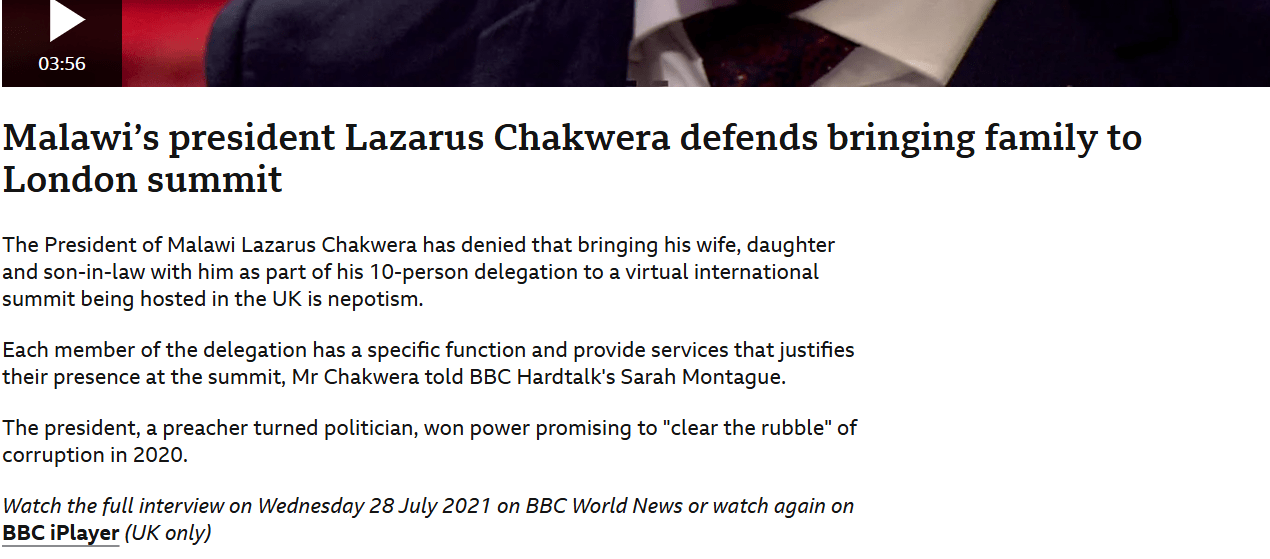
Critics also say that Chakwera’s government has ignored numerous conflicts of interest including in procurement. There has also been controversies like appointment of Violet Chakwera, Lazarus Chakwera’s daughter to a Missions Assignment in London and this 2024 trip by Chakwera’s son to Serbia) and the Virtual Summit debacle (see below), have all tarnished Lazarus Chakwera’s presidency, and provided ample fuel to his critics.
The electoral process itself is under scrutiny, with concerns about the legal framework, electoral integrity, and the introduction of new Electoral Management Devices (EMDs) – which some analysts fear are prone to manipulation.
This article provides an analysis of the 2025 Malawian Elections, exploring the historical context, key candidates, election dynamics, economic challenges, and broader implications for Malawi’s future. However, it does not endorse any candidate nor speculate on their electoral prospects.
Malawi’s Electoral System
The 2025 Malawian general election is the second to be held under the 50% + 1 constitutional threshold, a significant electoral reform introduced after the annulment of the 2019 elections. The 2019 elections (dubbed the ‘Tipp-Ex Elections‘) were nullified by Malawi’s Constitutional court due to widespread irregularities, leading to a fresh presidential election in 2020 that brought Lazarus Chakwera and Saulos Chilima to power. This reform requires a presidential candidate to secure an absolute majority (more than 50% of the vote) to win the election. If no candidate achieves this threshold, a runoff election will be held within 60 days, involving the two most popular candidates. This two-tier system was introduced to enhance the credibility of election results and to address the systemic flaws exposed by the 2019 electoral crisis. It’s effect has been to change electoral strategies, making coalition-building a key focus due to the unpredictability of shifting alliances and emerging parties. And since no one candidate is likely to win outright. This dynamic, although good for the democratic process, adds an element of unpredictability to the elections, as candidates position themselves not necessarily because of what they have to offer to Malawians, but instead their capacity to reshape the political landscape.
The Malawi Electoral Commission (MEC) has enrolled 7.16 million voters, with women constituting 57% of the voter roll, highlighting the importance of gender inclusivity in the electoral process. The MEC has also introduced 6,500 Electoral Management Devices (EMDs) sourced from Netherlands-based Smartmatic International Holding B.V. to modernize the electoral process. However, the introduction of these devices has been met with mixed reactions, with concerns being expressed about transparency and potential interference with the voting process.

- MEC’S CONTROVERSIAL IT PARTNER (Platform for Investigative Journalism)
So who are the most prominent candidates?
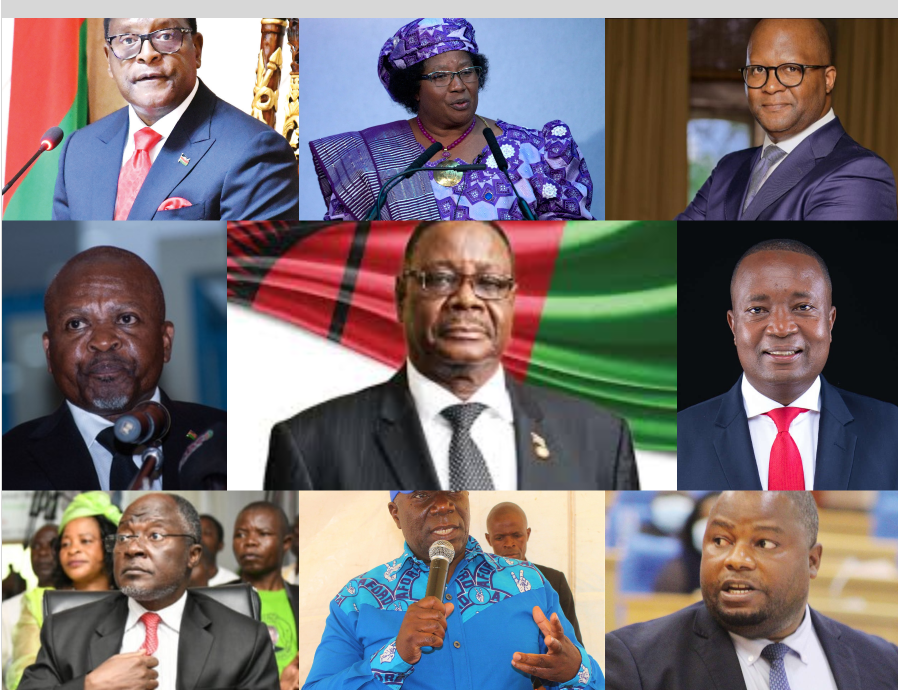
Lazarus Chakwera
Lazarus Chakwera, the incumbent President, is seeking a second term in office. He was elected in 2020 following the annulment of the 2019 elections and the subsequent rerun. Chakwera is running under the Malawi Congress Party (MCP) and has centered his campaign on addressing economic challenges such as high inflation, foreign exchange shortages, and poverty. While in his first term he had pledged to create a million jobs for the unemployed youth and to ensure food security so that all Malawians eat ‘three meals a day‘ – promises which many argue have not been fulfilled, his 2025 campaign includes a fresh set of promises including the creation of 3 million jobs by 2030. However, his administration has faced criticism for failing to manage the country’s economy effectively, with issues such as rampant corruption, shortage of FOREX, high unemployment rates, and skyrocketing prices of basic goods making him unpopular amongst many voters.
Peter Mutharika
Peter Mutharika, a former President of Malawi (2014–2020), is running on the Democratic Progressive Party (DPP) ticket. He has a long history in Malawian politics and has positioned himself as the candidate to save the country from being ruined by the current government. Mutharika’s is 85 years old, and his campaign focuses on economic recovery and governance, emphasizing his experience and past achievements. His selection of Jane Ansah as his running mate has generated intense public discourse, with some viewing it as a strategic move to bring political maturity and renewal, while others see it as controversial due to her divisive role in the 2019 elections. Here a more in-depth commentary is necessary. Ansah’s tenure as the Chairperson of the Malawi Electoral Commission (MEC) during the nullified 2019 elections has been a point of contention. However, it is noted that she did not nullify the elections herself but oversaw a process that was later scrutinized by the courts (which is seen as a part of Malawi’s maturing democracy). Her resignation from MEC in 2020 was viewed as an act of responsibility and sacrifice to preserve national peace and unity.
Joyce Banda
Joyce Banda, a former President of Malawi (2012–2014), is running with the People’s Party. She has emphasized the need for a new vision for Malawi, focusing on economic recovery and governance. Banda, who has chosen his former Vice President Khumbo Kachali as running mate, and is pushing a campaign of fixing the country’s challenges. Banda is a significant figure in the political landscape in Malawi, and she has used the campaign to emphasize her global connections. Her tenure as President was marked by efforts to address economic challenges, but her impact on the current political landscape is probably less pronounced compared to other candidates.
Michael Usi
Michael Usi, the current Vice President of Malawi, previously declared his bid to lead the United Transformation Movement (UTM) following the death of its founder, Saulos Chilima. He became UTM leader, until Dalitso Kabambe replaced him at UTM’s convention last year. Shortly after, an internal battle ensued, and Usi was expelled by the party. He decided to form his own party named Odya Zake Alibe Mlandu. His strategic positioning and personal brand resonates with the electorate, especially people in the rural areas.
Dalitso Kabambe
Dalitso Kabambe, a former Reserve Bank Governor, is running with the United Transformation Movement (UTM). He is viewed as a candidate who could bring innovative ideas and solutions to governance. Kabambe’s campaign focuses on bringing fresh perspectives and innovative ideas to governance. He aims to address the economic challenges faced by Malawi and has highlighted the need for new approaches to governance. But his previous links to DPP, and his limited political experience and lower name recognition compared to more established politicians may pose challenges.
Atupele Muluzi
Atupele Muluzi, the son of former President Bakili Muluzi, is a prominent figure in Malawian politics and is running under the United Democratic Front (UDF) banner, under which he has contested twice before. Muluzi has a background in Economics and has served in various governmental roles, including as Minister of Economic Planning and Development and Minister of Health. His campaign focuses on economic development, youth empowerment, job creation, and improving healthcare services. Muluzi’s political experience and his family’s legacy in Malawi’s politics, and their influence in the Machinga and Mangochi areas make him a notable contender in the 2025 elections.
What about the others?
In addition to the above, there is also a considerable number of fringe candidates and independents who have collected or submitted their nomination papers, but whose popular appeal remains largely unknown. While not as prominent as some of the leaders of the major parties, the fringe candidates may provide alternative choices and address specific regional or sectoral concerns. Further, if the vote does go to a second round as is believed it will, these candidates will likely hold some sway when alliances begin to be ‘crystallised’, in preparation for the second round.
Here’s a look at some key fringe candidates and their campaigns:
Enock Chihana: the leader of AFORD Chihana has been a fixture of Malawi’s political landscape for a while. His campaign is pushing for a united opposition to challenge the ruling party, focusing on democratic governance and social welfare. Chihana says he’d like to see democratic governance, economic development, and social welfare. He aims to address the economic challenges facing Malawi and improve the livelihoods of its citizens through inclusive and sustainable policies. According to several sources, Chihana is part of the Northern Alliance that will be supporting DPP if there’s a second round. However, AFORD’s Vice President Timothy Mtambo distanced himself from this alliance a few days ago, which also reveals deep divisions within AFORD as to how to approach this election.
- https://www.facebook.com/watch/?v=1460094108502781 {This Link purportedly shows Chihana finalising an Alliance agreement with Jane Ansah}
Kondwani Nankhumwa: He is a prominent figure in Malawian politics and is the leader of the People’s Development Party (PDP), which he formed after being expelled from the Democratic Progressive Party (DPP) in 2024. Previously, he served as Minister of Local Government and Rural Development and was a key figure in the DPP, including as Leader of Opposition in Parliament. His campaign emphasizes rural development, infrastructure improvement, and economic empowerment for all Malawians. And has chosen Bertha Ndebele, an MP from Balaka West, as his running mate. Nankhumwa says this highlights gender balance and unity, and it should matter because 57% of registered voters are women. Nankhumwa, like Atupele Muluzi represents a challenge to the status quo and a fresh vision for Malawi’s future. But his new party’s organizational machinery, despite claims of a membership of at least 3 million members, does not appear to be developed enough. And so it remains to be seen the extent to which he will appeal to voters outside the Lhomwe belt (districts of Chiradzulu, Thyolo, Mulanje, and Phalombe).
- https://fb.watch/B5vA0RC7s0/ {Kondwani Nankhumwa’s Interview – Times Exclusive}
Dr. Cassim Chilumpha: A former Vice President, Chilumpha runs independently, focusing on economic revival and social justice. Chilumpha is leveraging his former government experience under UDF. His political career includes serving as Minister of Defence, Education, and Justice under various administrations, including those of Bakili Muluzi and Bingu wa Mutharika. Chilumpha’s campaign focuses on economic revival, social justice, and improving healthcare and education services, leveraging his extensive experience in government. His candidacy is significant as it represents a return to politics for a figure who has previously been at the center of Malawi’s governance. In recent reports, he has called for Malawians to trust him, citing his proven track record in governance.
Dr. Daniel Dube: From the Nationalist Patriotic Party, a pulmonologist by training, and intensivist, and brings a unique medical perspective to the political arena. His campaign focuses on local empowerment, health and public service. Aside from championing a nationalist agenda, improving access to quality education, healthcare reforms, and empowering marginalized communities, his broader political agenda appears to be less defined.
Adil James Chilungo: An independent candidate promoting innovative agricultural solutions like organic fertilizers, emphasizing self-reliance. He has a background in business and economics and his campaign centers on economic reform, job creation, and improving the business environment in Malawi. Chilungo’s business track record and his proposals for economic revitalization make him a notable contender in the 2025 elections.
Cosmas Felix Chipojola is another independent candidate with a focus on grassroots development and community empowerment. He has a military background and according to a LinkedIn entry, he spent some years in Ireland. His campaign emphasizes the need for inclusive growth, improved healthcare and education services, and sustainable agricultural practices. Chipojola’s commitment to youth community development and his proposals for addressing the needs of rural areas make him a notable option outside traditional party structures.
Others who have collected nomination papers are Frank Tumpale Mwenifumbo (National Development Party (NDP)), Kamuzu Walter Chibambo (People’s Transformation Party (Petra)), Smart Swira (Independent), Milward Tobias (Independent), Kwame Bandawe (Anyamata, Atsikana, Azimayi (AAA)), David Mbewe of the Liberation for Economic Freedom Party (LEFP), and Reverend Hardwick Kaliya (Independent).
Election Dynamics and Key Issues
It is highly likely that there will be a runoff election, a possibility that now underscores the competitive nature of Malawian politics. The introduction of the 50% + 1 system has transformed electoral strategies, making coalition-building a key focus due to the unpredictability of shifting alliances and emerging parties. This system was introduced to enhance the acceptance of election results and to address the systemic flaws exposed by the annulment of the 2019 elections.
The 6,500 Electoral Management Devices (EMDs) form part of an effort to modernize the electoral process and ensure a more transparent and efficient voting system. Some people see using EMDs as a step towards enhancing electoral transparency, while others have raised concerns about the potential for vote rigging and the lack of transparency in the procurement process.
MEC has stated that it is open to an audit of the electoral process, but any such audit must be guided by a clearly defined scope and based on specific irregularities or anomalies observed in the electoral process or data. The Centre for Democracy and Economic Development Initiatives (CDEDI) – a local civil society organization (CSO) – and other CSOs, have voiced their reservations about the procurement of the new electoral technology, adding to the concerns about the transparency and fairness of the electoral process. Last July, one activist even claimed that the upcoming elections would be rigged.
While there are many issues that Malawians face, arguably the key issues that will shape the election are the economic challenges of high inflation, currency devaluation, and poverty. In particular, rising inflation, foreign exchange shortages, and the rising cost of living have eroded public trust in the current administration. Research data shows that over 70% of Malawians live on less than $2.15 per day, highlighting the severity of economic challenges. Education, healthcare, and infrastructure development are also issues which voters hope will be addressed by the next government, although the economic challenges appear to be more urgent.
Voter apathy is a notable concern, attributed to inadequate civic and voter education, frustration over unfulfilled campaign promises, and a lack of real viable choice among the electorate. The delay in passing the Presidential, Parliamentary, and Local Government Elections Bill of 2025 has raised concerns about the legal framework governing the elections. Proposed amendments aim to streamline the resolution of electoral disputes and enhance the role of the Supreme Court of Appeal, which are crucial for ensuring a credible electoral process.
Broader Implications of the Election
What will the implications of this elections be? The new leader, whosoever he/ she will be, will come into a position that is wrestling with many challenges. And so, they will be expected to move quickly to deal with the myriad of challenges the country faces.
There will be no honeymoon period.
Politically, a peaceful transition will yet again signal that Malawi’s democracy is maturing, such that the days of bitter fights and political violence are behind us. Socially, people will now start getting used to the idea of no party having a single majority. Which means political parties must give ground to form alliances. This means compromises will become standard, and in order to win, there will be a need to reach out to others, maybe even characters you don’t necessarily like, and strike deals with them. Economically, Malawi needs resources, so whoever wins this election will be judged on their capacity to mobilize resources quickly to re-ignite the ailing economy.
Financial assistance from the likes of the IMF and the World Bank Group amongst other international organizations will be important in the short term, but the new leader should look beyond these organisations towards reforms that promote economic growth, reduce poverty, and improve governance. Decentralization and devolvement of powers from Lilongwe to the districts will encourage addressing local problems with local solutions. Regional integration and collaboration with Zambia, Mozambique and Tanzania will also be key in revitalising the and diversifying the economy.
Ultimately, Malawi needs to find a strategy that attracts investment. And we need to scale our activities to support private sector growth, job creation, increased energy generation, better access to energy, improved agricultural productivity and diversification, as well as greater access to healthcare, and finance.
Role of Social Media and Public Discourse
Social media platforms have become important tools for political engagement, providing opportunities for direct communication between candidates and voters. Even the Government’s use of social media has been quite impactful. This interactive capability is essential for mobilizing voters and raising funds during elections. Political actors leverage digital affordances beyond simple messaging tools into structured framing mechanisms to shape public discourse and influence voter engagement. For instance, when candidates employ contrasting economic narratives and competing visions of education to influence public discourse and voter engagement, social media can be used to gauge people’s reactions.
But the use of social media in political campaigns is not just about messaging but also about buy-in, and for creating structured framing mechanisms to deliver outcomes to the people. Thus, even after the elections, social media can be successfully utilised for a better democratic approach to some of the country’s challenges. This has been done before in the past in many other countries.
In conclusion, this Election represent an important juncture for Malawi’s political and economic future. It’s the first time that the 50% + 1 vote threshold will be tested in a fresh Election in the absence of a nullified prior vote. It’s also the first time that EMDs will be used.
Considering the electoral landscape, it’s inevitable that coalition-building will determine the outcome of a runoff. Nevertheless, it will be interesting to see, for example, the extent to which tribalism and regionalism plays a role in the selection of a President, since in the past, it’s been an undeniable feature of voting patterns by Malawians. The role of social media too in shaping public discourse and voter engagement will be interesting to observe, as candidates leverage their digital platforms to influence the electorate.
The broader implications of the election extends to Malawi’s economic trajectory, governance, and international relations. These Elections are anything but just another political event. Instead they will be remembered as a pivotal moment that will shape the country’s future, and will inform all stakeholders as to what to expect from Malawi going forward. The outcome will have significant implications for Malawi’s economic stability, investment climate, governance priorities, and long-term growth prospects.
© 2025 MalawiAce.com
 malawiace.com