

The Vice President of Malawi Michael Usi has triggered another minor controversy, this time regarding his foreign visits.
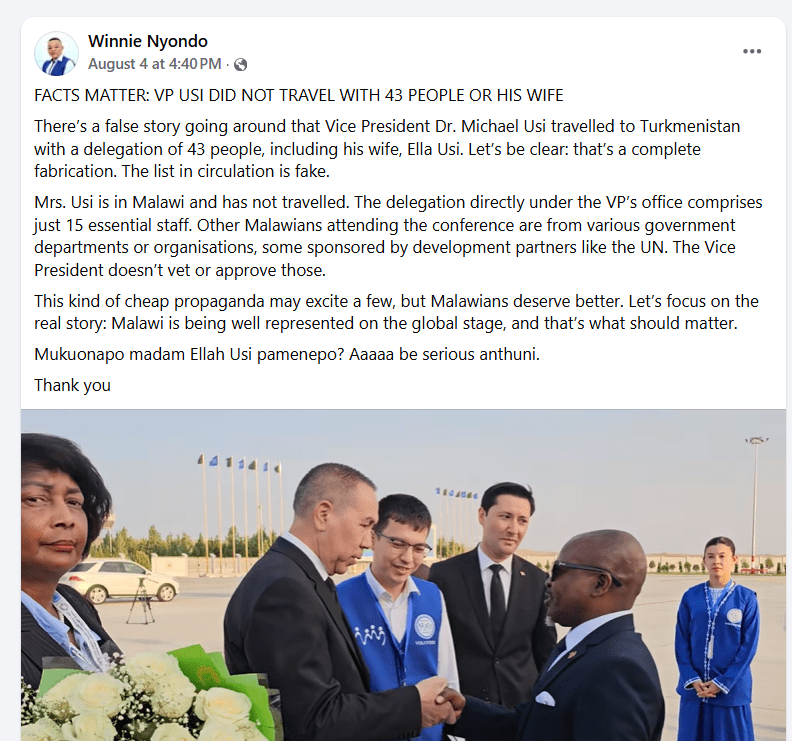
Usi flew off to Turkmenistan on Monday for a conference with 43 people in his entourage (so the online reports say). And this has angered some Malawians – who are struggling with an economic crisis back home. They say how can the vice president be wasting valuable resources gallivanting away into the sunset, while we are failing to find money and food to look after our families. However, others say the news is false, and Usi in fact traveled with only 15 people. The other Malawians who traveled were sponsored by NGOs or other government departments, not the VP’s office.
Now, whatever you think of dear old Manganya (the name he used in his previous profession as a comedian), I think what you should be more concerned about is not necessarily how many people he took on his trip with him, but what added value each one of them will make. Yes, what will their attendance of the conference contribute, and what does the maths look like?
And here, let’s just be clear that I’m not supporting the idea of a president, vice president or indeed any high-ranking official taking a large contingent of minions as an entourage to some foreign trip. Of course I don’t like the idea of politicians making lots of expensive trips, when Malawi is already struggling with Forex shortages. Foreign trips may be glamorous or fun for politicians, but flying business class to attend such and such a conference, on the state’s budget isn’t exactly a definition of fiscal discipline.
And that’s a problem. Because in Malawi, officials have been known to carelessly wander off into some distant land under the guise of official business – when they are in fact going on what is undoubtedly a state-sponsored holiday. Or more commonly, a shopping trip.
You had President Lazarus Chakwera flying off to London to attend a virtual conference – which was absurd, and temporarily made Malawi into a laughingstock. At least on X, the incredulity was discombobulating. And then, I think there’s been an incident where a team from some government department flew to Dubai for a capacity building exercise (when they could have invited the trainer who was conducting that training to Malawi – at a much lower cost).
So, what I’m I saying? What I’m saying is that there has to be a way to ensure that these trips add value, and do materialize into a list of tangible independently verifiable deliverables. Yes, the maths should add up.
Picture this: two or three business deals are signed during a visit (and afterwards the companies involved actually see through the agreement to fruition). A heads of agreement into an investments deal into Malawi is signed, educational outcomes (e.g. scholarships to 15 Malawian students) are made, markets for agricultural exports facilitated, even if such a transaction is merely trade in commodities (e.g. an order of 5,000 bags (50kg) of unprocessed sugar or groundnuts), maybe even some machinery locally manufactured in Turkmenistan is ordered – which will help add measurable efficiencies to some process back home.
Why is that picture so hard?
You want to see such tangible actions. These trips should count for something greater than the initial government expenditure on the trip. It makes foreign trips to be beneficial to Malawi, otherwise this habit of taking official foreign trips whose real benefit to Malawi cannot be quantified or ascertained isn’t in our best interest. Its wasteful, it needs to stop.
 malawiace.com