
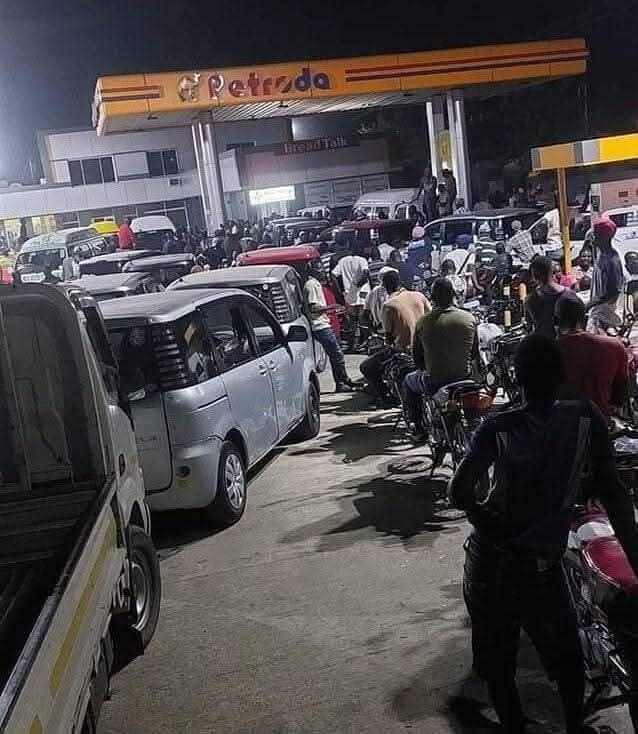
Will Malawi ever put an end to fuel shortages? I mean, will we ever get to a position where fuel imports and reserves are in a stable balance? Where the country has enough fuel for motorists, as well as reserves in case of shortages, so that fuel queues at petrol stations are truly a thing of the past?
Don’t get me wrong, there are global events that happen, and which disrupt global supply chains, causing widespread havoc including shortages of goods and commodities for EVERYBODY, from Germany and Ireland, to Brazil and Mexico.
But that’s not what I’m taking about.
What I’m saying is, it seems to me that Malawi in recent years has had a near-perpetual problem of fuel shortages. Every single year, or every other year, there’s a fuel shortage.
And the solutions we have thus far thrown at the problem, have either not worked, have only partially worked, or are not sustainable enough to continue working over the long term.
I mean, do you ever remember hearing news of a fuel shortage when Kamuzu Banda was the president of Malawi? I may have been young then, but in that 30 year rule, I think we only had fuel shortages twice or three times.
In 30 fat years.
Now, there are reasons for that, we had fewer cars, the cost of fuel was much cheaper than it is now, and we didn’t have many Forex shortages (I think there was a ban of Forex externalization at one point).
But the most important reason was that Kamuzu was an effective operator, and had effective operators in his government. He also put in place sound economic policies which worked. So, of course problems tended to be dealt with using permanent solutions, rather than “patch-up” or reactive temporary solutions, as is the case now.
There were other external reasons for the fuel shortages we had in the 70’s and late 80’s, like the Mozambican Civil War’s disruption of key rail routes, and regional tensions involving RENAMO and South Africa. But by and large Malawi had fuel most of the time.
However, since the dawn of multiparty democracy, it seems like there has been acute failures at the helm, with not just anticipating the fuel demands of a growing economy, but a lack of preparedness or forecasting to ensure that there is ample supply, and disruptions are at least minimised. This has been the case since aCheya was in power.
Further, our excesses in giving public officials free fuel (fuel allowances) paid for by the state is not helping our country’s finances. That scheme is extremely costly, and in my view should be scrapped immediately. Why not let the majority of public officials, other than ministers, travel by public transport? Or use their own money to make all these journeys?
Money that cannot be re-claimed as expenses.
There are far too many officials in Malawi, making unimportant journeys, on the public purse. Literally with fuel paid for by the tax payers. This is unsustainable and should stop.
Once we have started to cut back on this wasteful expenditure, then we’ll start seeing our public finances slowly recover. I know there are officials in Malawi who don’t care about how public funds are utilised. And this is the chief reason why the country is broke…
Lack of accountability.
Another important issue that can help Malawi save money is the use and adoption of electric cars. Because in 2025, why are we still spending hundreds of thousands of dollars we do not have to buy expensive top of the range Land Cruisers?
- The VX Land Cruiser factor – why Africa is still poor (Daily Maverick)

This is money that we should be using for much better purposes like building factories and creating avenues for employment for young people. Money that we should be using to build an actual economy…not what we currently have.
If we build factories, we can produce goods that others can buy. If we buy a VX, it depreciates from day 1, and we never see that money again… it’s basic financial literacy.
Why not take a different approach? Instead of holding on to the newest 200 cars the government has purchased for top civil servants, let’s sell them at around 85% of their purchase price. The proceeds could then be used to buy second-hand, more affordable electric cars along with the necessary charging infrastructure. For example, instead of spending $150,000 on a single VX, you could buy and ship 6 units of the VW ID.4 below(or similar electric vehicle), as well as at least 10 units of 22kw fast chargers. All including shipping to Malawi.
And the ID.4 will not give you a poorer performance in comparison to a VX…in fact it would perform just as well, if not better – when you consider the comparable savings (fuel vs electric charge) it would provide.


Why are Malawi’s leaders not thinking like this?
The chargers could be installed by local electricians, with training provided directly by the manufacturers. To support this, solar panel arrays could be set up at the government departments where the chargers are installed, and where the vehicles will be parked overnight – an ideal fit given Malawi’s abundant sunlight.
This would be a true plug-and-play solution: it would create jobs for local technicians, increase their skills, open up career opportunities in the solar and electric vehicle supply chain, reduce our dependency on fuel imports, and ultimately save the government millions of dollars of valuable Forex (and wasteful fuel allowances).
 malawiace.com