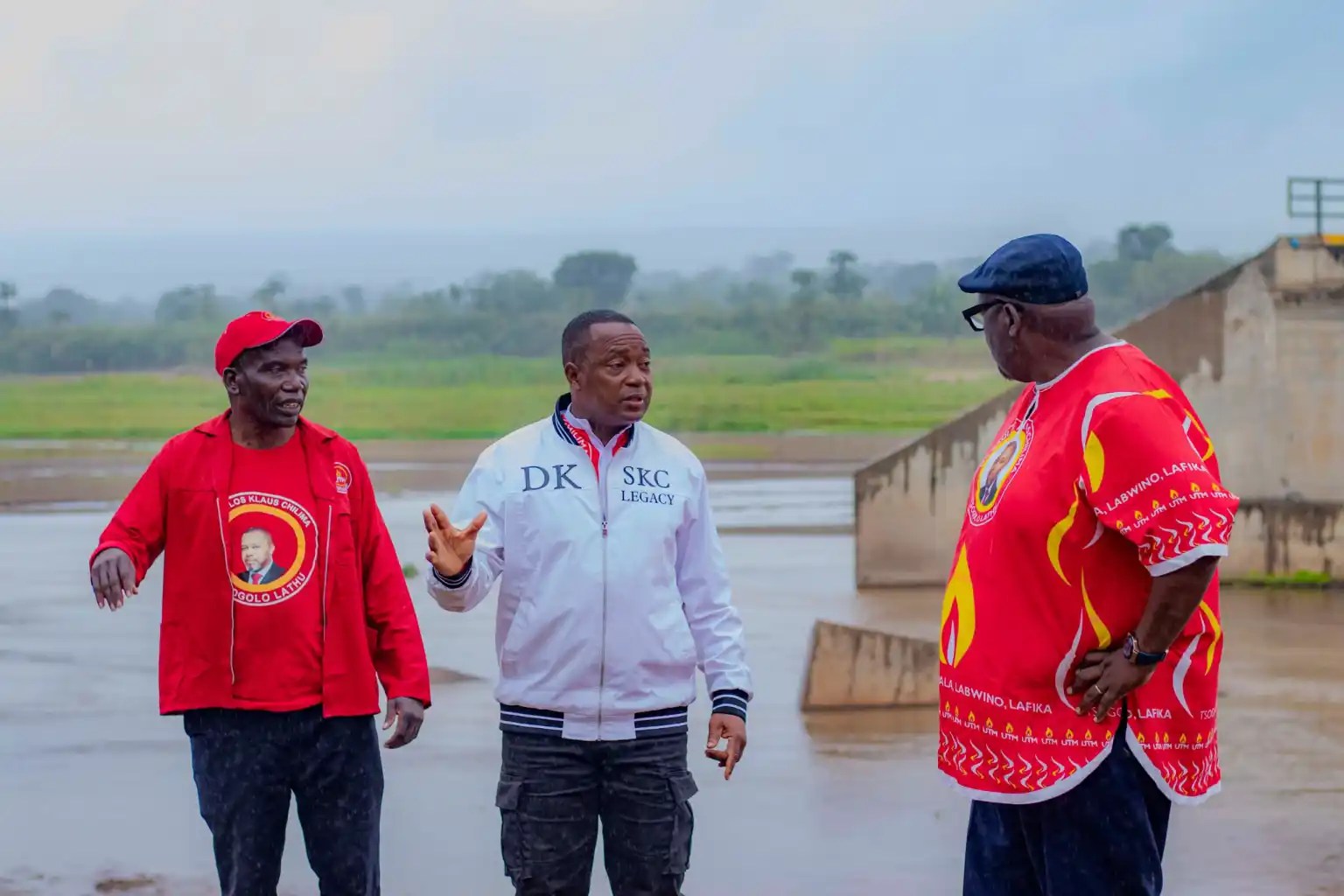
In the sometimes chaotic landscape of Malawian politics, few figures have risen as quickly and prominently as Dalitso Kabambe.
The new president of the United Transformation Movement (UTM) was elected last November to succeed the late Saulos Chilima, at a party convention whose outcome surprised most people. Kabambe, a professional economist and former civil servant, emerged as a winner, beating established UTM figures like Newton Kambala, Mathews Mtumbuka and Patricia Kaliati. His journey to the helm of one of Malawi’s youngest but most influential political parties is as puzzling as it is impressive. But who exactly is Dalitso Kabambe, and what does his rise mean for Malawi’s future?
Background
Born in Lilongwe, from a father who comes from Ntcheu and a mother from Thyolo, Dalitso Kabambe grew up in Lilongwe, Salima and Nkhotakota, where one may say he started to appreciate an understanding of Malawi’s socio-economic challenges and opportunities. He did his secondary school in Thyolo, before earning a Bachelor’s degree in Economics from the University of Malawi. He later completed a Master’s Degree at the University of London, in the UK, before earning a PhD from Imperial College London. This academic background laid the foundation for his career in economics and public service, equipping him with the skills that would later define his political career.
Public Service
Before entering politics, Kabambe built a career in finance, working firstly as an Economist at the Ministry of Agriculture. Eventually he became a Principal Secretary at the Ministry of Foreign Affairs and International Cooperation. He subsequently became Budget Director after serving in various other capacities, before serving as the Governor of the Reserve Bank of Malawi (RBM) (April 2017 to July 2020), where he played a pivotal role in stabilizing the country’s economy and implementing policies to foster growth. His tenure at the RBM was marked by a focus on controlling inflation (reducing inflation from 28% down to single digits), ensuring currency stability, and promoting financial inclusion. He also says he brought down interests rates from 24% to 13% during his tenure. All this work earned him a reputation as a pragmatic and results-driven leader, and his supporters flag this up as proof that he can handle the country’s economy. Along his public service career, he has also worked as an economic adviser for the late Chakufwa Chihana (when Chihana was second vice-president), as well as for late Aleke Banda (when Aleke Banda was a government minister). Kabambe says he learned work-ethic among other qualities while working for these highly esteemed Malawian political heavyweights.
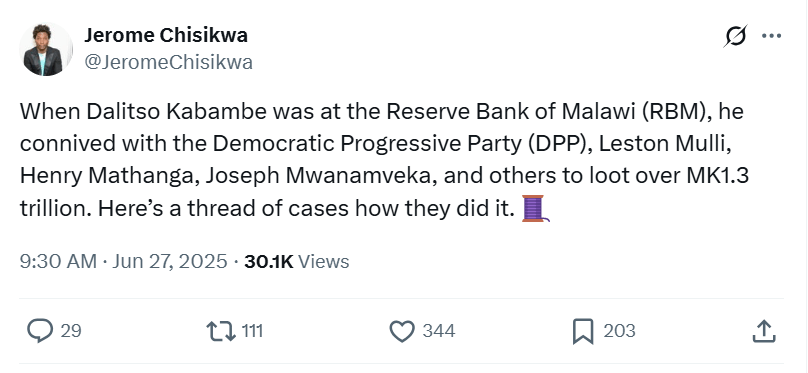
However, there were also major problems. In January 2021, he and three others were charged with four counts of financial impropriety, including money laundering. The case was filed after a forensic audit by Deloitte revealed that the central bank had made several irregular payments to companies linked to the former ruling Democratic Progressive Party, including to a local bank listed on the Malawi Stock Exchange. The forensic audit also showed that Malawi was misleading the IMF regarding meeting performance benchmarks, during the time he was RBM governor (see here and here). Kabambe refutes the allegations and denies any wrongdoing, but the case is ongoing.
Kabambe claims his professional expertise extends internationally, where he represented Malawi in various economic forums. His ability to articulate Malawi’s economic challenges and advocate for sustainable solutions, he says, showcases his leadership on a global stage. This international experience Kabambe says honed his diplomatic skills and deepened his understanding of the interconnectedness of global and local economies.
Entering Politics
According to Kabambe, his entry into politics seemed like a logical progression of his desire to contribute to Malawi’s development on a broader scale, because he said he noticed that so many things were wrong in Malawi and thought those who were in charge were doing a bad job. So he decided to do something about it. He previously joined the Democratic Progressive Party (DPP), in December 2020, but resigned last year (2024). Before his resignation, Kabambe expressed his intention to run for the DPP Presidential candidacy, but critics say he left DPP when he learned that Peter Mutharika would contest in this years election. Others claim his exit actually came when DPP fired Kondwani Nakhumwa and Nicholas Dausi, among others. He says Mutharika was at that point his mentor as well as DPP party’s leader and he didn’t want to compete with his mentor. Whichever it is, when he joined UTM, Kabambe’s rise within UTM was immediate, and on a certain level caused discontent as some UTM heavyweights felt like he had come from nowhere to muscle away the leadership position, to which they felt more entitled.

But Kabambe says his rise reflects the trust and confidence that UTM members placed in his leadership abilities. But his critics privately disagree, claiming the real reason Kabambe won the nomination was a bit more sinister, and shows the other side of the man.
Nevertheless, his election marks a new chapter for UTM, as it seeks – post the Chilima era – to position itself as a formidable force in Malawi’s political arena yet again. Thus, objectively, Kabambe’s leadership may either bring a fresh perspective that revitalizes the party, or it will be the last straw that finally breaks the camel’s back.
Vision for Malawi

Dalitso Kabambe’s plan for Malawi focuses on transforming the economy to make it stable, diverse, and prosperous for everyone. As a former Governor of the Reserve Bank of Malawi, Kabambe believes that the country’s economic decline can be stopped by implementing predictable financial policies. He’s got an austerity plan and wants to cut expenditure in the public sector, especially at State House, OPC and within the civil service. He says he wants to move the economy away from relying too heavily on agriculture (which is prone to climate change and price fluctuations), and towards a more balanced economy that includes industry, urban development (K100 Billion a year each to all the Districts), and private sector growth. This will create jobs, especially for Malawi’s young population, and provide opportunities for education and innovation.
In the agricultural sector, Kabambe proposes a significant overhaul to increase productivity and commercialization, making Malawi a major food producer in Africa again. This includes growing high-value crops (Cotton for example) and developing value-added products. He also wants to modernize farming methods to ensure food security and abundance for farmers. Additionally, his plan includes developing the mining industry by leveraging Malawi’s untapped resources, such as oil and gas, gold, and graphite.
Kabambe’s policies on domestic manufacturing are rather ambitious. He says he aims to boost manufacturing and tourism to create jobs and stimulate economic growth. These plans include promoting value-added industries and tourism through bold initiatives which attract investment, and creates opportunities that meet the growing demands for public services. His strategy includes revitalizing these sectors with clear plans and reforms to reassure investors, while emphasizing innovation and digital transformation.
At the heart of Kabambe’s agenda is a commitment to inclusivity, aiming to bridge the gap between urban and rural communities and ensure that no Malawian is left behind.
UTM has been proud to repeat the claim that they are a party for all Malawians, not built on tribe or regional lines.
Thus, Kabambe has emphasized the importance of leveraging Malawi’s agricultural potential, promoting industrialisation, and investing in education and technology to drive sustainable development across the whole country – not just in areas where party leaders come from. He is a strong advocate for good governance and transparency, pledging to fight corruption and ensure that public resources are used efficiently for the benefit of all citizens.
As you can see, all very well and good.
But Kabambe’s vision for governance reforms that prioritize transparency, accountability, and anti-corruption measures may prove harder to achieve in practice. While he wants to create a people-centered government that serves as a social contract with citizens, encouraging civic participation may prove much difficult to achieve than balancing the books at the Treasury or within RBM. Ask Timothy Mtambo.
Nevertheless, Kabambe believes by shifting resources towards health, education, and human capital development, he can equip the youth with skills, capital, and opportunities.
Prospects on September 16 Elections
But Dalitso Kabambe’s prospects in the September 16 elections are uncertain and not assured, with many questioning whether UTM under his leadership has a genuine chance of winning. Kabambe’s rigid stage presence and lack of charisma compared to his predecessor, Saulos Chilima, may hinder his ability to connect with the masses. While he’s effective in press conferences and in one-to-one media interactions, his communication style doesn’t resonate as strongly with ordinary people.
The divisions that have occurred within UTM is another factor. A faction of UTM members broke off to join Michael USI’s new party, Odya Zake Alibe Mulandu Party. But even before that, some UTM supporters had defected to MCP.
And with the oncoming elections, there are several presidential candidates from the South all vying for the Southern Vote. This may make it challenging for UTM to secure enough votes in the south. Kabambe’s lack of grassroots connection and lingering allegations related to the IMF misreporting case may also work against him. Especially because his political critics are using this in their campaigning as an attack vulnerability.
Despite these challenges, Kabambe remains a formidable candidate, particularly among educated youth, economic professionals, and voters disillusioned with the slow pace of economic development. His experience as former Governor of the Reserve Bank of Malawi and technocratic profile are significant strengths. The selection of Dr. Mathews Mtumbuka as his running mate has been seen as a strategic move to bolster his campaign, although it remains to be seen to what extent exactly this will help him.
Kabambe’s emphasis on economic reform, youth empowerment, and public sector efficiency resonates with many Malawians. For UTM supporters, Kabambe may represent a promise of progress and renewal. But the ultimate test of Kabambe’s leadership, and the extent to which Malawians beyond his support base have bought into his vision, will come on September 16, when Malawians go to the polls. Until then, Kabambe remains just another candidate aspiring for Malawi’s presidency.
- Former central bank chief touts his plan for Malawi (African Business)
 malawiace.com