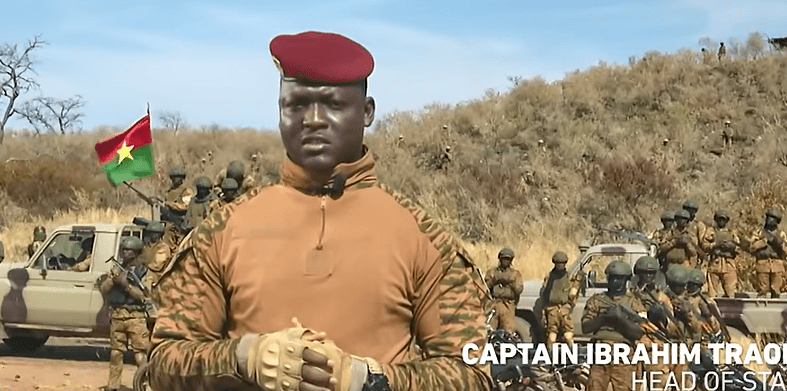
The September 2022 military takeover in Burkina Faso that brought Captain Ibrahim Traoré to power marked more than just another coup in West Africa’s turbulent political landscape. At 34 years old, Traoré’s ascension as the world’s youngest head of state symbolised mounting regional frustrations with both domestic governance and international partnerships. His leadership has since become a focal point in debates about sovereignty, security, and the changing face of African politics.
The Context Behind the Coup
Burkina Faso’s political upheaval didn’t occur in isolation. The country sits at the heart of the Sahel region, where a perfect storm of challenges has for many years fueled instability. The region faces persistent jihadist violence linked to Al-Qaeda and ISIS affiliates that has killed thousands and displaced over 2 million Burkinabè citizens. In addition, as is the case in many African countries, there is chronic poverty as well as youth unemployment. Finally, climate change has intensified resource competition and magnified agricultural challenges.
When Traoré led his coup against interim leader Paul-Henri Damiba (who had himself taken power just eight months prior), he tapped into deep-seated public anger over these unresolved issues.
A New Style of Leadership
Traoré’s governance approach marks a decisive break from his predecessors in several key ways.
Diplomatic Realignment
The young leader has fundamentally restructured Burkina Faso’s international partnerships. His administration has expelled French military forces and diplomatic personnel, terminating long-standing defense agreements with Paris, and built stronger relations with other military-led governments in Mali and Niger. Further, he has pursued closer ties with Russia, though it appears he is maintaining strategic ambiguity about relationships with groups like Wagner.
Domestic Policy Initiatives
Internally, Traoré has launched a number of ambitious but controversial programs. He has established a massive civilian militia recruitment drive to combat jihadist threats. He has also initiated reviews of mining contracts with international companies. Further, Traoré has proposed construction of state-owned mineral refineries which he hopes will help with job creation and increasing the value of exports. There have also been symbolic changes implemented, such as reverting colonial-era place names to their historical alternatives.
But Burkina Faso’s most pressing challenge remains the security situation. While his approach combines aggressive counterinsurgency operations in jihadist-controlled territories, integration of civilian defense volunteers into military units (Volunteers for the Defense of the Homeland (VDP) or Les Volontaires pour la défense de la Patrie), and coordination with foreign military advisors, it remains to be seen to what extent these strategies will be successful.
Already, some analysts are pointing out that since he came to power, there have been over 3,000 events linked to jihadist violence in the region. But the source of that data is unclear. The numbers too do not add up (See: Burkina Faso’s Ibrahim Traoré is making waves in west Africa. Who is he?).
Challenges and Criticisms
Human rights organizations have raised concerns about civilian casualties and questions persist about the long-term sustainability of his security approach. The closure of French military operations will have created operational gaps(there were about 400 French soldiers operating under the Sabre Task Force at the Kamboinsin base, near Ouagadougou).
Further, despite his official image, there is some evidence that suggest that Traoré’s actual support among citizens is limited. The junta has violently suppressed dissent, thwarted multiple attempts on Traoré’s life, and presided over continued violence and humanitarian challenges. The regime has also targeted independent voices, including journalists, civil society activists, political figures, and members of the judiciary, using tactics like forced conscription.
According to several reports, a number of Burkinabè journalists who criticized Captain Ibrahim Traoré were forcibly conscripted to the frontlines, as part of a broader campaign targeting dissenting voices. The most notable case is Atiana Serge Oulon, editor-in-chief of L’Évènement, who was taken from his home by intelligence agents in June 2024. Traoré himself acknowledged conscripting a critical journalist on state television, widely understood to be Oulon, who was then sent to military training and subsequently to the frontlines as a VDP.
This practice extends beyond Oulon, with journalists Alain Traoré, Kalifara Séré, and Adama Bayala similarly disappearing in 2024, reportedly conscripted by the junta. Human rights organizations have documented how critics are deliberately sent to dangerous conflict zones, particularly in the northeast of the country where jihadist activity is high. And despite a December 2024 court ruling declaring such forced conscription illegal, Traoré’s regime continues to use a 2023 decree allowing conscription of adults over 18 as a tool against dissenters.
Economic Vision and Resource Nationalism
Traoré’s economic policies reflect a broader push for resource sovereignty as well as regional economic integration with like-minded states. His government has said there are plans to renegotiate existing mining contracts with international firms, as well as increase investment in domestic processing capabilities for mineral resources. The emphasis is very much on economic independence from former colonial powers.
But looking at the situation objectively, does Burkina Faso have enough experts to competently grow and run their economy? Or will they need expertise from abroad, as well as instructors and advisers in specialist fields? If they will need specialists, how much will that cost?
Traoré’s leadership style has found particular appeal beyond Burkina Faso, especially resonating with young African audiences. His public persona, as a young military leader who portrays strength, youthful vigor, boldness and courage, contrasts sharply with the traditional image of aging and unfit African heads of state, presenting what some see as a more dynamic and assertive form of leadership.
MalawiAce.com
Beyond Burkina Faso, many of Traoré’s admirers, including on social media say he wants to finish the work which Thomas Sankara started. At this juncture, a list of the major achievements of Sankara are in order.
Key achievements of Thomas Isidore Noël Sankara:-
1. Renamed Upper Volta to Burkina Faso in 1984, meaning "Land of Upright People," symbolizing dignity.
2. Vaccinated 2.5 million children against meningitis, yellow fever, and measles in weeks, reducing infant mortality.
3. Increased literacy from 13% to 73% by 1987 through a nationwide campaign.
4. Planted over 10 million trees to combat desertification in the Sahel.
5. Built roads and railways, including nearly 100 km of rail, without foreign aid.
6. Appointed women to high government positions, a first in Africa.
7. Granted women pregnancy leave during education and recruited them into the military.
8. Banned forced marriages and polygamy, promoting gender equality.
9. Redistributed land from feudal landowners to peasants.
10. Suspended rural poll taxes and domestic rents to ease burdens on the poor.
11. Established Popular Revolutionary Tribunals to fight corruption.
12. Slashed salaries of top officials, including his own, to reduce inequality.
13. Launched a housing program, building brick factories to replace slums.
14. Created 5,384 village pharmacies out of 7,500 villages by 1987.
15. Boosted cereal production by 75% between 1983 and 1986 for food self-sufficiency.
17. Recognized the AIDS epidemic early, a pioneering move in Africa.
18. Changed the national flag and anthem to reflect revolutionary ideals.
19. Encouraged local production by mandating public servants wear Faso Dan Fani clothing.
20. Oversaw construction of schools and health centers nationwide.
21. Promoted Pan-Africanism and anti-imperialism, rejecting foreign aid dependency.
22. Initiated the first National Culture Week in Ouagadougou in 1983.
23. Advocated for a united African front against foreign debt at the 1987 OAU summit.
Global Implications
Traoré’s leadership style has found particular appeal beyond Burkina Faso, especially resonating with young African audiences. His public persona, as a young military leader who portrays strength, youthful vigor, boldness and courage, contrasts sharply with the traditional image of aging and unfit African heads of state, presenting what some see as a more dynamic and assertive form of leadership. If his policies succeed, it could positively influence political stability across the Sahel. Further, the pivot away from French influence sets precedents for other African nations, and if the approach to counter-terrorism succeeds, that too may reshape regional security strategies.
But there are concerns regarding Burkina Faso’s international relations with it’s new allies. The growing Russian influence in West Africa in general is a cause for concerns for western countries. However, with a pro-Russian President in the White House, it remains to be seen how the dynamics in Washington will play out in the Sahel. Still, how will alliances with Russia and with China, crystallize into tangible benefits for the Burkinabè people? Shouldn’t Burkina Faso also seek Economic assistance in the fields of Transport, Manufacturing, Education and Infrastructure Development? Further, how will they balance the new international partnerships without creating new dependencies. Or without risking Burkina Faso’s assets to a new set of Neo-colonial interests.
- BURKINA FASO: a €45m Chinese loan for the Donsin solar power plant (Africa Energy Portal)
There have also been concerns that renegotiating mining contracts could affect global mineral markets. But this risk is minimal because many other African countries do suspend and renegotiate contracts as part of economic transitions following a change of government, without triggering a crisis.
Under Traoré, Burkina Faso has an opportunity to reset the clock. To deliver tangible security improvements and institute beneficial reforms while maintaining popular support among the Burkinabè population. He can choose to roll out more equitable resource management, and crackdown on corruption, to demonstrate that alternative development models for African countries exist, in spite of all the complex challenges and pressures African countries often face.
As things stand, his transitional government embodies a new generation’s approach to persistent challenges in West Africa, and so far his impact on regional politics and international relations is undeniable. The success or failure of this experiment could reshape political dynamics across the Sahel and influence future debates about sovereignty, security, resource nationalism and development in Africa. In any case, if the US is now constantly talking about ‘America First’ as a new policy direction that focuses their resources on the United States and it’s people, why shouldn’t any African Government roll out policies that prioritises their country?
 malawiace.com
[…] https://futures.issafrica.org/blog/2025/Can-Ibrahim-Traore-turn-the-fortunes-of-Burkina-Faso-around https://malawiace.com/2025/02/23/captain-ibrahim-traore-redefining-leadership-in-an-unstable-sahel/ https://allafrica.com/stories/202501130299.html […]
LikeLike