
Cheaper fertilizer is a A Step Towards Malawi’s Self-Sufficiency. High Prices are pulling the country backwards.
With almost anything a country imports, the pricing point is dictated by external forces, often beyond the control of the leaders of that country. Unless the country is willing to allocate substantial import subsidies to keep prices low for its citizens, it makes economic and strategic sense to manufacture as much as possible of certain essential goods domestically – especially when the raw materials of those goods are readily available. And when the country doesn’t have an endless supply of cash.
In Malawi, one of the most pressing societal issues is the skyrocketing cost of fertilizer, an important input for the country’s predominantly agrarian economy.

The Fertilizer Crisis in Malawi
When the Tonse Alliance Government led by Lazarus Chakwera came to power in June 2020, the market price of a 50kg bag of fertilizer in Malawi in 2020 was approximately MK22,000. By April this year (2025), the market prices for Urea and NPK have risen to approximately MK112,000 and MK115,000, respectively. To put this into perspective, the Affordable Input Programme subsidized prices were MK4,495 in 2020 and MK15,000 in April 2025.
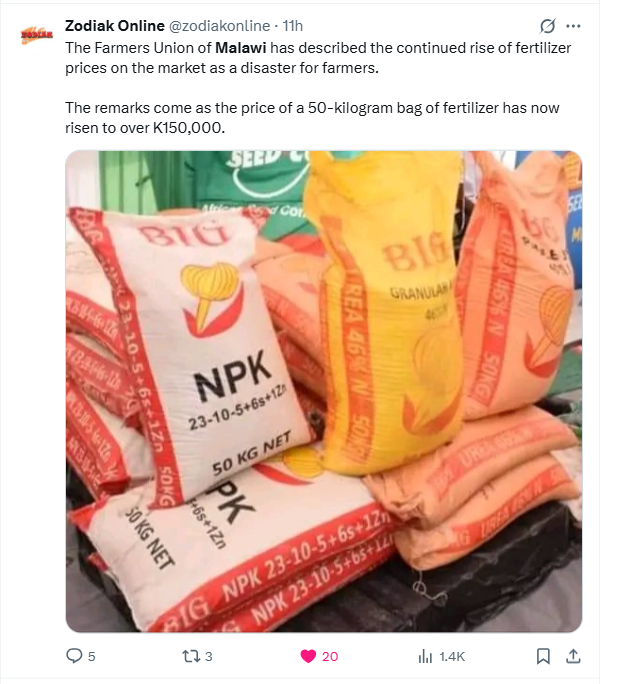
For a country where 70% of the population are below the poverty line, the increase in fertilizer prices makes it too expensive for many smallholder farmers. And seeing the problem of distribution and shortages with AIP, the price surge undermines food security and perpetuates poverty in a country where agriculture remains the backbone of the economy.
Broken Promises
One of the cornerstone promises of the Tonse Alliance was to ensure that fertilizer prices would be affordable for the majority of farmers. Yet, five years later, the reality on the ground tells a different story. In recent weeks, Chakwera’s running mate for this year’s presidential election Vitumbiko Mumba has constantly put the blame for the 2020 promise of cheap fertilizer, on UTM’s then leadership of Saulos Chilima. A claim UTM is yet to refute.
The Role of Subsidies Globally

Subsidies are not unique to Malawi. Many countries use them to protect their agricultural sectors and ensure food security. For instance, France provides substantial subsidies to its farmers under the Common Agricultural Policy (CAP), while India subsidizes fertilizers to keep prices low for its vast rural population. In 2024 alone, French agricultural subsidies amounted to €9.6 Billion. These examples highlight the importance of government intervention in stabilizing critical inputs like fertilizer.
PressCane Limited’s Fertilizer Factory
In March of this year, the Malawi Broadcasting Corporation (MBC) reported that PressCane Limited would open a K10 billion fertilizer manufacturing plant in Chikwawa District by May(2025). The plant, located in Dyeratu, was expected to produce 10,000 tons of fertilizer annually, significantly boosting domestic production. The report said that the fertilizer was going to be made from effluent (treated waste water from their ethanol production).
- Wastewater turned into fertiliser gold (The Furrow)
If operational, this facility will bring the number of fertilizer ‘manufacturers’ in Malawi to three, joining Optichem and the Malawi Fertilizer Company (MFC) – both of whom use blending plants. This increase in local production could potentially increase supply, and reduce reliance on imports, helping to stabilize prices, and fulfill Chakwera’s campaign promises. But only if the project is successfully completed and starts production.
However, it seems that completion of the factory (or the commencement of production) has encountered delays. But we haven’t been able to determine what the real reason for this delay is (or for that mater what the problem is). A request for comment to PressCane Ltd remained unanswered at the time of writing this article.
The Broader Implications
Having local production is a big deal. Comparing dogs and cats here, but this is for example why Aliko Dangote was willing to go through ‘hell’ just to complete and kick-start local petroleum processing…
So, more locally based large scale fertilizer manufacturers within Malawi will help introduce competition. This will hopefully help lower the prices down. It will certainly reduce dependency on imported fertilizers, insulating the country from from global price fluctuations so that smallholder farmers have access to affordable fertilizer. This, in turn, could boost crop yields, improve food security, reduce inflation and lift millions out of poverty.
It cannot be stressed enough that a country like Malawi would be better served by diversifying its sources of fertilizer, rather than relying solely on a few companies or foreign imports.
Another alternative approach to fertilizer production involves significant investment in small-scale organic fertilizer plants, which can be locally managed at the village level, or in medium-sized plants at the district level. The machines for these are already in existence, and their production lines are relatively straightforward to design and set up. Additionally, some of these plants could potentially be adapted to run on biodiesel rather than electricity. Malawi’s policymakers should prioritize introducing these accessible technologies into the country and conduct trials to determine the most suitable solutions for the our unique needs.
- Fertilizer Manufacturing in Malawi (Fertilizer Association of Malawi)
 malawiace.com