
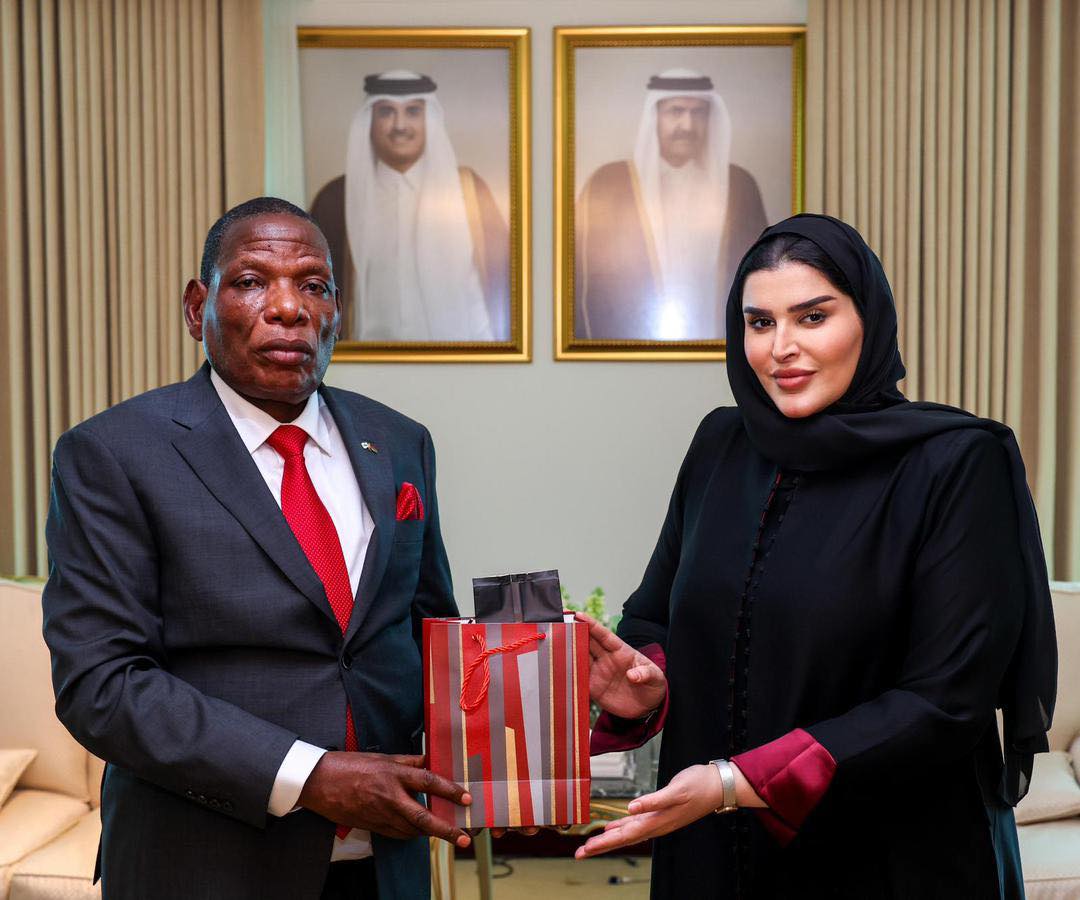
Joseph Mwanamvekha, Malawi’s Finance Minister, is a busy man. The other week last October, when Donald Trump was meeting the Australian Prime Minister Anthony Albanese, and taking pictures in the Oval office, while discussing Rare Earth Mineral deals, including a landmark US$8.5 billion framework agreement on rare earths and critical minerals, Mwanamveka was just two blocks away, a few hundred yards down the road, at 1818 H Street, NW … in the World Bank Headquarters.
The US-Australia framework deal is designed to secure supply chains for defense and green technology while reducing reliance on China, which currently dominates global processing. It specifically targets the $8.5 billion pipeline of “ready-to-go” projects, which would include the outputs of a refinery belonging to another company called ILUKA Resources. What was probably not discussed between Trump and Albanese, but is still material to the conversation is that an Australian company, Lindian Resources, has a large concession of rare earths in Malawi – the Kangankunde Rare Earths Project which is one of the world’s largest rare earths deposit. And that via lluka Resources, Malawi-mined Rare Earth minerals, will find themselves in the US Tech and Defense sectors.
I suspect Mwanamvekha may have been thinking about all these below-the-surface details when he watched the Tv reports of the meetings happening a few hundred yards away in the White House.
Why this matters
ILUKA Resources, believe it or not, is a central part of the broader U.S.-Australia rare earth strategy, even though it was not one of the two “immediately” funded projects named during the October 20, 2025, White House meeting. But following the signing Iluka’s stock price surged by 9.1% as investors recognized its inclusion in the framework. Further, major reports from the Center for Strategic and International Studies (CSIS) and other policy analysts explicitly list Iluka as a critical Australian company within this framework.
So, from what I can see it appears like this transaction will work as follows: Lindian Resources will mine and export Rare Earth Mineral Ores to Australia from Malawi. Iluka meanwhile will happily receive these Ores, process them then export them to the US, as part of the above framework; earning top dollar for Lindian, their investors, and for IIuka, and it’s investors.
Anyway, back to Mwanamvekha, a couple of weeks ago, when President Peter Mutharika was preparing to go to South Africa, Mwanamveka was in Doha, Qatar, and in Abu Dhabi, UAE.
What took him there? Well, to put it diplomatically he was on an ‘official visit’ not too dissimilar to what took him to Washington DC. But in plain English, Malawi needs dollars. And lots of them. So Mwanamvekha has been given what sardonically is known as the “begging bowl”, the unenviable task to go round and round, looking for … dollars.
It’s a hard task for anyone given an economy that is a modest $14 billion in nominal GDP. To put it into context for the average person, this is roughly the size of the 2025 -2026 budget of Los Angeles, a relatively small US city. So, Malawi is presently being expected to perform fiscal gymnastics and use $14 billion of value to try and serve 22.5 million people, when the city of Los Angeles uses nearly the exact same amount of resources on just … 3.86 million people. It’s comparing apples and oranges of the same value, but you get what i mean.
The problem couldn’t be clearer.
Malawi’s situation is also especially difficult given shaky global conditions like high debt burdens, and geopolitical uncertainties that are making it tougher for African nations to secure funding and foster growth. Further, Malawi continues to grapple with a severe foreign exchange crisis that’s left businesses high and dry, unable to import essentials without jumping through hoops or resorting to the black market. Banks are scraping the bottom of the barrel for dollars, leading to fuel shortages, skyrocketing inflation. To top it off, power cuts choked economic activity throughout 2025.
And that’s before you get to the local currency, the Malawi kwacha, which has been under immense pressure, with parallel market premiums ballooning over 150% at times, creating distortions that encourage shady dealings and erode trust in the financial system.
Fertiliser scarcity worsens (Nation Malawi)
Despite the new government’s assurances against devaluation post-election, reserves have dwindled to just two months of import cover, forcing tough choices on everything from food to medicine imports.
The IMF and others have been waving red flags, urging reforms to rebuild those buffers before the whole house of cards comes tumbling down. I’m sure on his Washington visit, these points were highlighted back to Mwanamvekha quite a few times.
But the assistance provided by organisations like the IMF often don’t leave enough room or fiscal flexibility, in my view, for the maneuvering that’s required to build lasting and resilient systemic change.
The new government under President Mutharika, fresh off the September 2025 elections, is staring down a barrel of crises including a nationwide food emergency affecting over four million people. Joseph Mwanamvekha has been repeating this fact on his travels. As well as the fact that Malawi now has a fiscal deficit that’s ballooned past K3 trillion thanks to election splurges of the previous government.
On top of this, a lapsed IMF program and rising poverty, which is projected to push hundreds of thousands more Malawians below the line, are testing their mettle, demanding swift reforms amid cost of living woes which hit the vulnerable the hardest.
So, all our problems are happening against a backdrop where Malawi-mined Rare Earth minerals will soon be earning investors top dollar via the US Tech and defense sectors…
Does anyone else care whether Malawi and its people will receive a sufficient and proportional return from their raw Rare Earth minerals? Or should Malawians have to yet again fight the same old resource-control battles we fought with Paladin, another Australian company?
What can be done? What must be done?
First, the Government of Malawi should double down on transforming its agriculture sector, the backbone of the economy that employs over 80% of the population and drives exports like tobacco and tea. In distressed economies, growth often sparks from leveraging natural strengths with smart investments. Here, think Rwanda’s post-genocide pivot to high-value crops or Ethiopia’s irrigation boom during droughts. Malawi could urgently roll out subsidized modern farming tech, like drought-resistant seeds, local organic fertiliser manufacture and small-scale irrigation systems, while creating farmer cooperatives to cut out middlemen and boost value addition through processing plants.
This isn’t about begging for aid but mobilising resources that can ignite self-sustaining productivity that leads to lower food imports. With climate shocks drought hammering yields, this move could stabilize food supplies for the majority of people who are facing a hunger crisis.
The New Visa Rules
Similarly, our tourism industry needs an overhaul. Which is why the new visa rules recently announced by the Government are important. On the principle of reciprocity alone, why should Malawian nationals continue paying hundreds of thousands of dollars in visa fees abroad, while at home, we exempt nationals of countries where our citizens face the highest costs in visa fees? It doesn’t make sense for a country that urgently needs foreign exchange…
Industrial Strategy
In addition, we need to kick-start industrial revival and job creation. The government must slash red tape and empower the private sector, much like how Kenya bounced back from its 2008 crisis by fostering SMEs through tax breaks and easily available credit. Malawi’s youth bulge, with a median age of around 18 is a goldmine of untapped entrepreneurs, that are currently stifled by bureaucracy, high interest rates on loans, collateral burdens and ofcourse the forex shortages that choke imports for businesses.
Thus, there should be one-stop business registration hubs, and young people should have access to low-interest loans via local banks. These should be specifically for startups in manufacturing or agro-processing. We should also incentivize tech adoption with training programs, as well as encourage mechanization by distributing farming and industrial equipment to the cooperatives mentioned above.
Our country’s development will not happen by a miracle. Instead, this is about deliberately creating a buzzing ecosystem where for example a Lilongwe-based mechanic can import spare parts quickly and easily without endless permits. And without relying on black market US dollars.
By doing so, you’d tackle the staggering unemployment and underemployment, creatively turning idle hands into economic engines. As well as diversifying away from aid dependency, as seen in successful turnarounds in several African countries.
Finally, we must mobilise local capital to invest in renewable energy infrastructure so that we can put an end to the crippling power cuts that have paralyzed factories and homes. Look at how Morocco harnessed solar during its energy woes to fuel growth. With blackouts stretching 8-12 hours daily and only 11% electrification, Malawi’s economy is literally in the dark. And yet as a country we have abundant sunshine and hydroelectric power generation potential greater than many other African countries.
Thus, the current government could fast-track public-private partnerships for solar farms and mini-grids, aiming for quick wins like powering rural clinics and irrigation pumps first. This isn’t pie-in-the-sky economics; it’s pragmatic growth hacking, reducing fuel import bills that exacerbate the forex crisis and enabling 24/7 operations for businesses. We know this because in distressed settings elsewhere, such infrastructure leaps have propelled nations like Ghana forward, creating jobs in construction and maintenance while building resilience against climate hits, ultimately illuminating the path to a more vibrant, self-reliant economy.
 malawiace.com