

A couple of days ago, an unlikely video went viral across Malawi.
In it, Blantyre City Mayor Isaac Jomo Osman, was being filmed live on his own Facebook page by one of his associates, as he physically slapped a woman suspected of receiving stolen goods during what appeared to be an anti-crime enforcement sweep. The footage was not ambiguous or discreetly filmed. No, Osman authorized its filming, he wanted it filmed, and streamed it live on his own Facebook page. The Mayor of Malawi’s commercial capital manhandled a civilian in public, surrounded by his associates – who reportedly also assaulted young men present at the scene.
Ofcourse the reaction was swift. Human Rights organisation after human rights organisation came out to publicly condemn the Mayor. The Malawi Human Rights Commission (MHRC) condemned it as a criminal act. The Human Rights Consultative Committee called it “barbaric and degrading.” The Human Rights Defenders Coalition called for his immediate arrest. UDF president Atupele Muluzi said no suspicion justifies violence. The two government ministries of Local Government and Gender issued a joint condemnation. Police summoned Osman to Southern Region Police headquarters, where a caution statement was recorded.
And they were right to condemn the actions of the mayor.
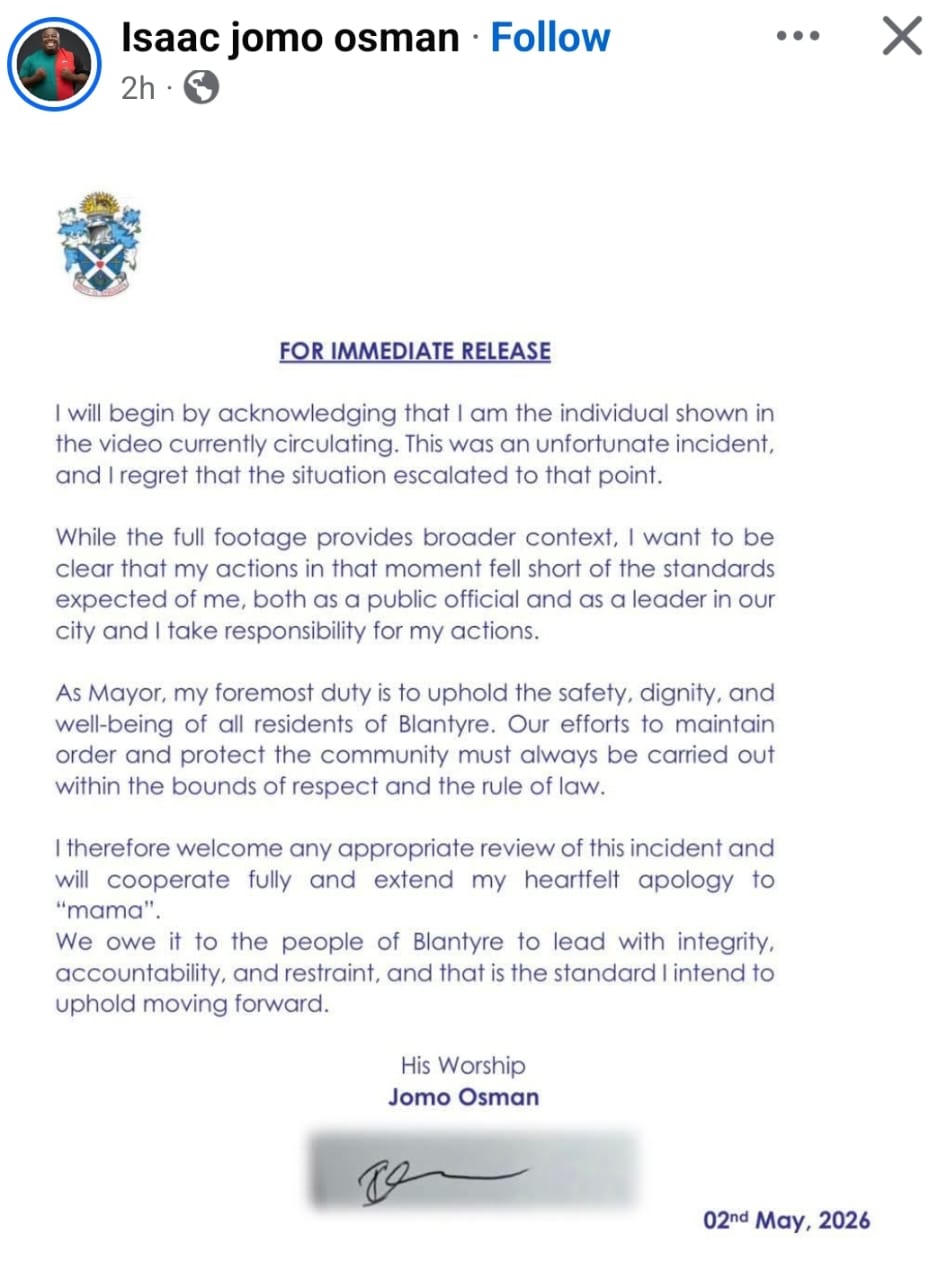
By Saturday, the Mayor had issued a public apology, accepting full responsibility and apologizing directly to the woman.
What should have ended there, however, has not, and indeed cannot.
Because beneath the viral clip lies a more uncomfortable set of circumstances, and questions. Circumstances about why Jomo did what he did. And questions about local criminality in Blantyre, about poverty and desperation in Malawi. Questions about a justice system that consistently fails ordinary people. And about what happens when a leader decides to be the law rather than uphold it.
What exactly happened?
The incident took place on the 1st of May 2026 or the day before, during what appears to have been an organised operation targeting stolen goods trading in Blantyre. Osman, who has been an active and visible mayor – much loved by Malawians across the country, was broadcasting the operation live on Facebook – a transparency choice that ended up being the instrument through which he was to be condemned.
The footage, part of which can be seen above on the TikTok page of the German broadcaster Deutsche Welle (DW Africa) shows a woman explaining something to Osman and he goes and grabs her, as she continues explaining. He then releases her momentarily before suddenly slapping her. She recoils but doesn’t fall and moves to one side and then he hits her again. She recoils again and almost falls. A longer version of the footage is available on Slice Magazine’s twitter page here.
Apparently, the woman is accused of buying stolen goods from young men who are sitting on the floor. Apparently Jomo’s associates who accompanied him reportedly also assaulted the other young men who were present. The broadcast captured children watching the violence unfold – a detail that the MHRC specifically flagged as compounding the harm.
Osman initially defended himself in subsequent interviews, and even released a subsequent video (that can be seen here on the TikTok page of another commentator), expressing surprise that the focus was on his conduct rather than the alleged crimes being addressed. He later reversed that position, issuing the written statement above acknowledging that his actions fell short of the standards required of him as a public official.
That stance we all agree is the correct position. Although it came about 24 hours too late.
Safeguarding the Rule of Law
Firstly, let us be really clear on this matter: Mayor Osman was wrong to smack that woman. Full stop. A public official, any public official, does not have the right to physically assault a civilian regardless of what that civilian is alleged to have done. Now Jomo is not the first public official in the world to have resorted to violence, and if you search online, you’ll find many examples of others who have done much worse. But as the MHRC chairperson Chikondi Chijozi said it plainly: no accusation, however serious, justifies taking the law into one’s own hands. Both the Constitution of Malawi and the African Charter on Human and Peoples’ Rights prohibit torture and cruel or degrading treatment. These are not Western impositions barked down from Washington, Brussels or London to the minions in Blantyre or Lilongwe. No, these are legal commitments Malawi has made to its own citizens.
The MHRC was also right to flag that the livestream itself was reckless because broadcasting a physical assault to thousands of followers, with children visible in the scene, does not just harm the individuals involved. It normalises violence as a civic tool – which is a danger in any society. It is unfortunate for someone who is much loved by people in Malawi, but Osman must face the consequences of his actions. And if the evidence supports an assault charge, he should be charged like any other citizen. The credibility of the already embattled justice system of Malawi depends on it.
What some members of the Public are Saying
But here is where the story becomes a lot more complex. The video below (in Chichewa) provides some context as to what was really going on. I will not translate it all, other than a brief summary, because he has talked about a lot of things:
But in short, its a local rehabilitation drive that shouldn’t have been filmed, because doing so has blown it out of the locality. They all know each other, the mayor knows them, and has been working hard trying to dismantle the networks, and to ‘straighten’ everyone out. He gathered everyone together to advise them. In fact it’s claimed Jomo has been paying them, and giving them capital to stop petty theft, and instead do legitimate work and start small businesses. But there has been resistance, and that’s why Jomo lost his cool.
So public reaction in Malawi has been sharply divided. For every voice calling for Osman’s arrest, there has been another defending him. And not because they think the assault itself was acceptable, but because they believe the woman in question is far from innocent. And that the institutions meant to deal with people like her have consistently failed to do so – as you’ll read below from other third party testimony. One member of a prominent citizen discussion group also echoed the claim that Osman had previously given money to the young men involved – attempting to rehabilitate them and help them start small legitimate businesses. Only for them to be reportedly drawn back into a life of crime – allegedly by the same woman he smacked. The source alleges that the woman who was hit is the organiser behind their criminal activity, sending boys to steal from homes and acting as the receiver and fencer of the goods. This claim is also echoed in the video above.
Obviously these are serious claims which have not been established in a court of law. But they have not emerged from nowhere either. Local outlets and social media commentary including reports on sites like 247Malawi have described her as allegedly running a network that exploits vulnerable young men, directing them into theft and handling the proceeds. The TikTok video narration in Chichewa above backs this also.
Victims, it is claimed, have spoken out. Whether that constitutes a pattern of exploitation that law enforcement has been aware of and failed to act upon is precisely the question nobody in authority seems to be answering. This matters, not because it excuses Osman – it does not – but because it provides context of what was really going on, and shows that the public divide on this story is not simply ignorance or misplaced sympathy for a powerful man.
A significant portion of Blantyre’s population is watching this story through the lens of a crime environment they live inside every day, and through years of watching theft networks operate openly with impunity while the formal justice system moves too slowly, too selectively, or doesn’t move at all (that phrase in the video above “aPolisi akungodya bubblegum”).
One commenter on another news site said: “Are we saying that thieves have more rights than the victims?”
That is not a sophisticated legal argument. But it is a real expression of something Malawian society needs to take seriously.
Now, some people I spoke with were equally vocal about the woman: She was “A gang leader,..masterminder ndi ameneyu“. Another said “Apparently she’s a boss of the street kids and little thieves in town. Akaba or kulandira ndalama they would give her. If a boy brings nothing, the punishment was to be sodimised by an older boy”
These are all allegations from people I have spoken to on condition of anonymity. Someone else said this: “Apparently she started blocking miseu and demanding money from drivers. Nkumawauza kuti if you don’t pay you will be sodomised”
When I asked why the police or any journalists haven’t apprehended her or written about her crimes, I was told that she knows people in high places, in the police, and that “she is too dangerous“. They said “Jomo being a former street kid, had tried to help the street women and kids kuti asamangidwe kupangila kuti ena amati amapanga this stuff chifukwa cha umphawi“. This clsim that he tried to give them loans and businesses but this woman seems to have “criminal instincts deep in her DNA“, is being made again and again by different people. So “it’s what she knows best….jomo uja kumukuntha kuja watopa naye” the source said. She said the mayor hitting her was a resignation, it was him getting tired with her, after failing to straighten her ways after many attempts.
The same person wrote this regarding the same woman: ‘Police in limbe know her very well even ma market leaders aja they know her koma basi amangoziyang’ana sinanganso amamuopa somehow‘ . That the police and market leaders know her but they don’t apprehend her as they are afraid of her.
When Public Institutions fail to do their jobs
Mayor Osman grew up as a street kid in Blantyre. That background is well documented and is part of why he is very popular and commands genuine respect in parts of the city. He knows the streets, the networks, the dynamics of urban poverty and petty crime from lived experience. He also has a reputation, rightly or wrongly, as someone who gets things done in a city that has seen too many mayors who did not.
None of that entitles him to assault civilians. But it does help explain why so many people, including some of evident standing and good sense, have rallied to his defence. And this is happening not because they want impunity for the powerful, but because they see in him someone actually doing something about longstanding problems nobody else is touching.
That is the uncomfortable truth at the centre of this story.
In any case, vigilantism does not emerge in a vacuum. It emerges when communities lose confidence in formal institutions that are supposed to protect them. When criminal networks can allegedly operate openly, when vulnerable young men can be organised into crime pipelines by adult handlers (in this case the woman is known as “Mama”), when victims see no reliable path to justice. In such an environment, some will celebrate whoever appears to be fighting back, even if the methods being used in the fight back are unlawful or downright illegal. It’s been like that throughout history, and not only in Malawi.
The HRCC’s statement hit on something important when it called for the Blantyre City Council to convene an emergency meeting on the Mayor’s conduct. But equally important is asking what that council, and the police, and the courts, have been doing about the crime conditions that produce these confrontations in the first place. That question too needs to be answered.
What needs to happen now?
Several things need to happen, and they are not mutually exclusive. Osman must be held to account through the proper legal process. If assault charges are warranted, they should be brought. Jomo’s apology is noted, but accountability in law is not the same as accountability in a press statement. So, unfortunately the police must demonstrate independence from his political connections and handle this the same way they would handle any citizen accused of the same conduct.
Secondly, the woman’s alleged role in running a criminal network exploiting young men must be investigated properly. If there is substance to the claims circulating in public – which many people think there is, that is a serious matter of organised crime and child exploitation. It deserves the same urgency the human rights bodies are rightly applying to the assault itself.
Obviously, her rights as an accused person must be respected throughout, but those rights include being properly investigated and, if the evidence supports it, being prosecuted.
Blantyre needs a serious, sustained effort on urban crime. Not mayoral enforcement drives, but the hard, unglamorous sustained institutional work of policing, prosecution, and restorative pathways for young men caught in crime networks.
We need a new Police task-force that is set aside, whose main job would be policing and breaking down criminal syndicates. We need teams that patrol those areas mentioned in the above video, 24/7. 365 days a year. Not the current detached police officers odya bubblegum which the young man above talks about, no. We need a new force which citizens can depend on for protection. Our people in these localities deserve both safety and dignity. They should not have to choose between them.
More broadly, when will Malawi’s leadership face up to why these things are happening? These are not isolated incidents that appear out of nowhere. No, instead, these incidents are symptoms of a much bigger problem. Because when a sitting mayor feels he can take the law into his own hands on Facebook Live, and when a significant portion of the public applauds him for it, it’s clear to any observer that the institutions of justice are not functioning as they should. And there is a problem that has been festering for so long – which ordinary people are sick and tired of. That is the real conversation this week’s events should be forcing.
Similarly, why are those young men joining gangs? The video of the young man above is instructive. He talks of 3 main gangs, the Black Bandanis, the Red Bandanis, and another gang … akuti kaya chani. These kids are joining these “crews” because there is some incentive to be had from being part of these gangs. Clearly they benefit from them in many ways.
So, let me ask again, why are these young men or women involved in those gangs?
Is it because there are no jobs available for them in society, and no sufficient number of training pathways for them to undertake with a view to improving their lives? Is it because there are no social safety nets like young people’s allowance (in some countries known as ‘job seekers allowance’)?
That discussion, however uncomfortable to Malawian leaders, also needs to be had.
Final Word
Isaac Jomo Osman has seen better days and weeks. The slap was indefensible regardless of what the woman may or may not have done. He has apologized. The legal process has started. So far, so good.
But dismissing the public sympathy he has received as ignorance or misogyny would be its own form of dishonesty. Many Malawians who have expressed understanding for his frustration are not endorsing assault. They are expressing exhaustion with a system that asks them to wait for justice that too often never comes. The answer to that exhaustion is not vigilantism. It is functional institutions. It is a police force that actively confronts and dismantles criminal networks – of which they are many in Malawi. The answer is courts that process cases. It is leadership that models the rule of law even when, especially when it is hard. Mayor Osman’s apology ended with a pledge to lead with integrity, accountability, and restraint.
Blantyre will be watching whether those words outlast this week’s unfortunate set of headlines.

