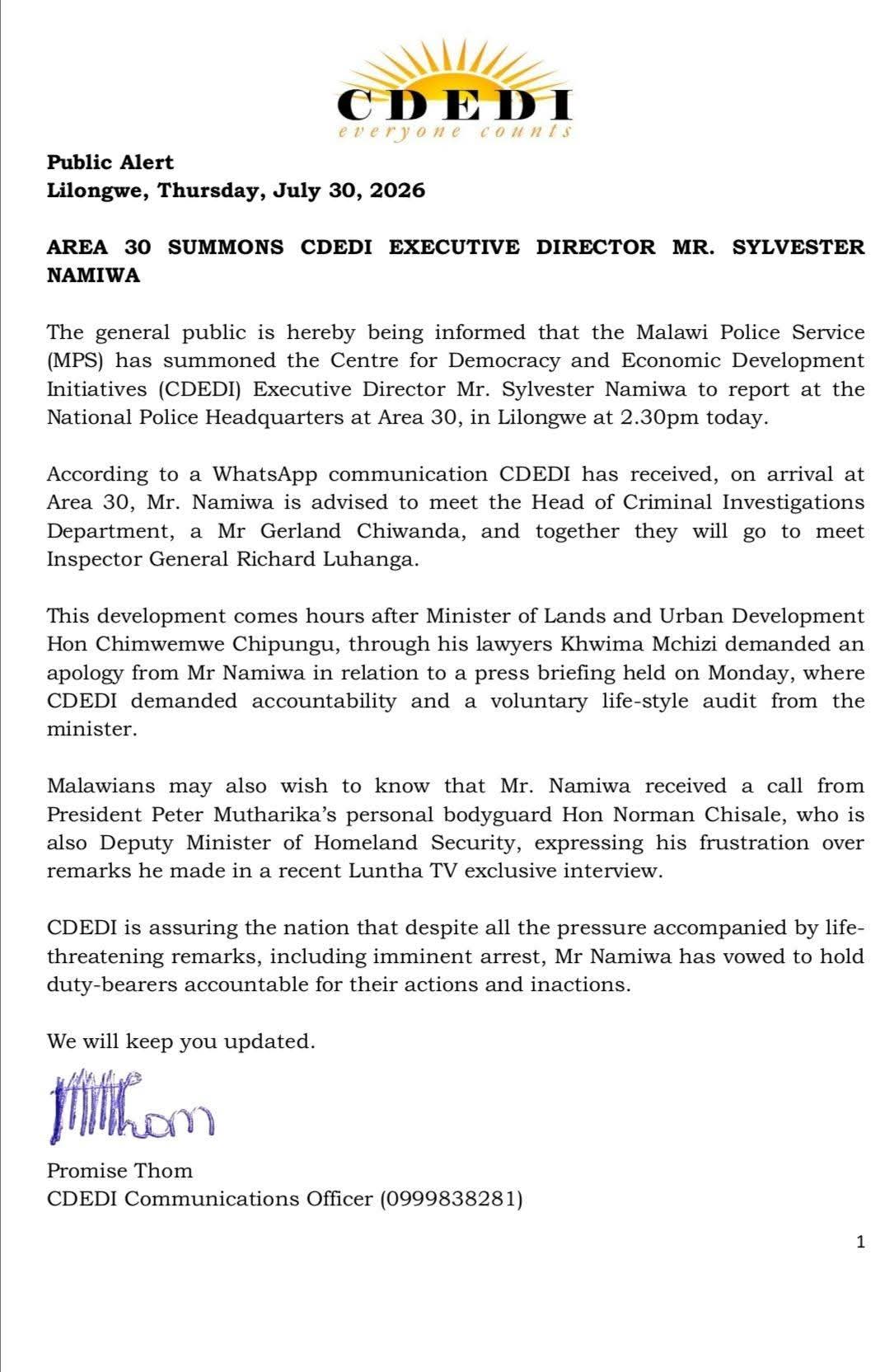
The letter above appeared online a few hours ago and reports on a development whereby CDEDI’s Executive Director Sylvester Namiwa has been summoned by the Malawi Police Service.
When I first saw it, my first thought was should a citizen or civil society leader face pressure simply for calling on public officials to comply with the law? What is wrong with us Malawians? Nkhani yake itiyo mukumuyitanira Sylvester ku polisi?
According to letter, Mr Namiwa was summoned to the National Police Headquarters in Lilongwe shortly after the organisation demanded accountability and called for Lands Minister Chimwemwe Chipungu to voluntarily undergo a lifestyle audit. The organisation claims that Mr Namiwa had received threatening communications in connection with his public remarks.
Whether one agrees with Mr Namiwa’s politics or not is beside the point. The central issue here is that Malawi already has laws requiring certain public officials to declare their assets, liabilities and business interests. The Public Officers (Declaration of Assets, Liabilities and Business Interests) Act was enacted specifically to promote integrity, transparency and accountability in public office. Its stated objective is “to promote public confidence in the public service”, while Section 15 requires listed public officers to declare their assets, liabilities and business interests.
The Constitution of Malawi also reinforces this principle. Section 213 requires holders of specified public offices to disclose their assets, liabilities and business interests within three months of taking office.
So where exactly is the problem here? Because from where I stand, and considering that legal background, for a civil society activist to ask for a lifestyle audit is not, in itself, an unreasonable demand. And it should not then be followed by intimidation or bullying by the powers that be. Unless of course there is something someone is trying to hide.
If there are public concerns or allegations regarding unexplained wealth, a voluntary lifestyle audit should be a fair vehicle that is used to clear a public official’s name. Just as much as it can also be used to expose wrongdoing.
Transparency protects both the public interest and honest officials. And if the police are being recruited to intimidate activists because they raise important issues, then the people orchestrating this are losing the plot. Because where does it all end? Do you really want to further tarnish the name of the Malawi Police Service – as a tool for political intimidation, as if we’ve not had too many examples like these already in the past?
Malawi’s asset declaration framework exists because public office carries a higher duty of accountability than ordinary citizens. Public officials are often in positions where they have access to state resources. And asset declarations are meant to safeguard against abuse of public office. Citizens should be free to ask legitimate questions as to whether these laws are being implemented fairly and consistently without fear of intimidation or bullying.
If the allegations contained in CDEDI’s statement are accurate, then the focus should not simply be on Mr Namiwa. It should also be on whether there’s anything that’s worth looking into around the Lands Minister’s affairs.
Malawi’s institutions should work to protect the constitutional rights of citizens, and leaders of civil society organisations do not fall outside the remit of that duty. Demanding accountability from those entrusted with public office is not a crime. So, like him or not, get your hands off Namiwa.

