
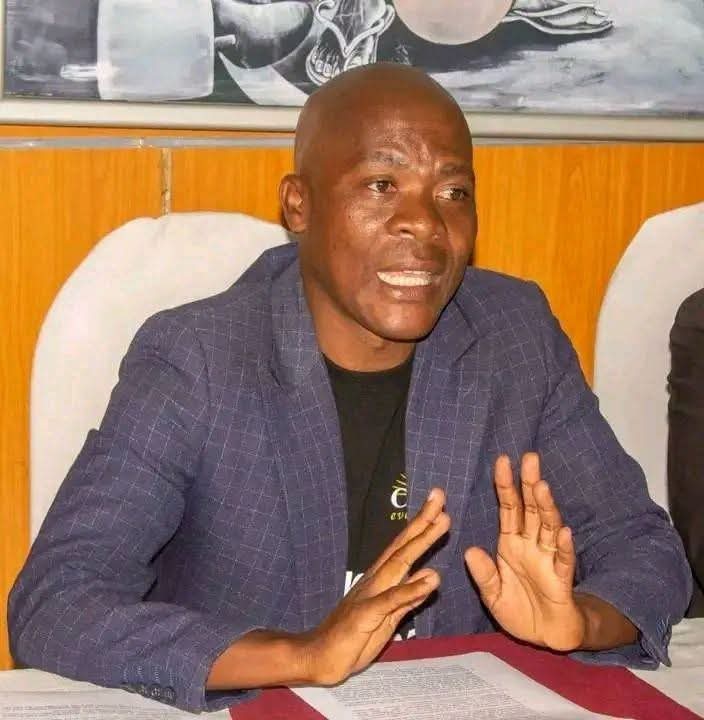
By some absurd logic, Sylvester Namiwa is said to have uttered “treasonous” things in a TV interview – remarks of the kind his organisation, the Centre for Democracy and Economic Development Initiatives (CDEDI), probably makes often (the videos are there for anyone who cares to watch). I have not seen the particular clip myself. But on X, and in Malawian news accounts, the line most commonly attributed to him from that July 2026 Luntha TV interview – the one said to have triggered both the treason charge and the publication-of-false-news charge – is this:
“If these actions do not change, Dr Jane Ansah will be the next president of this country within the next two months.”
Variants of the statement are circulating online, some tighter (“in the next two months the next president of Malawi is Dr Jane Ansah”), some in Chichewa summarising the same point for a domestic audience.
The context people attach to it matters: Namiwa was reportedly arguing that Ansah, the sitting Vice President, was being sidelined from Cabinet and official engagements, which is true. And that if the DPP-led administration carried on governing they way they were doing, and kept excluding her, they would effectively be paving her path to the presidency. Whether this is read as a near-term warning or as a longer-term point about where things were headed toward 2030 is irrelevant. It’s a statement by a government critic, of course he’ll say things the government will not like.
The Public Affairs Committee, through Bishop Gilford Matonga, condemned the remark as “criminal in nature,” asking how anyone rises to the presidency while a lawfully elected incumbent still holds office, and pressed the Vice President’s office to distance itself from it. The comments were not “criminal in nature”, and here I think the Bishop was being unnecessarily sensational.
Many saner heads online simply called it political commentary, which is what it is. Or an obvious enough observation about the direction of travel.
But not a call to arms.
So then, if that is roughly what he said, anthu inu, is that really treasonous? Isn’t there a real difference between saying “Let’s rise up and overthrow this government”, on one hand and “Norman Chisale ndi mbola” on the other?
And here is the part that the treason narrative conveniently buries: the Jane Ansah remark did not arrive in a vacuum. In the same Luntha TV interview, and in the press briefings around it, Namiwa had been naming names on unexplained wealth. He accused Deputy Minister of Homeland Security Norman Chisale – who also happens to be President Peter Mutharika’s personal bodyguard – of amassing suspicious wealth and building houses on land in Lumbadzi. And CDEDI said Namiwa received a personal phone call from Chisale himself, expressing frustration over those very remarks.
We have learned that he also turned on Minister of Lands Chimwemwe Chipungu, alleging that Chipungu had bought seven luxury vehicles worth roughly K2.8 billion, a hotel under construction beyond any known income that Chipungu as a public official is known to have earned. Namiwa is said to have also questioned ADL land dealings. These are allegations Namiwa later conceded he could not fully back with material evidence, which is precisely what prompted Chipungu’s lawyer to fire off a 48-hour retraction demand.
The police summons that started this whole sorry chain landed hours after that demand, not after the Ansah remark. He also called for a forensic audit of Beautify Malawi Trust, the First Lady’s charity, over allegations of wrongful enrichment. And, worth noting for anyone tempted to dismiss the wealth line as reflexive activist mudslinging: Chisale was already a known quantity on this front, having faced a K5 billion unexplained-wealth prosecution that the Director of Public Prosecutions simply chose to discontinue in March 2026. After DPP came to power. Clearly something’s going on there.
So here is the question the state doesn’t want asked. If a civil society activist is asking pointed questions about how a deputy minister on a government salary is building multiple houses, or how a lands minister is running seven luxury vehicles worth K2.8 billion, shouldn’t the authorities be looking at how they can investigate those allegations, rather than looking at how they can silence the man asking them?
In any normal country, that is exactly what would happen, the anticorruption bodies would be dispatched and a lifestyle audit, an asset declaration check, a proper investigation would follow. Osati zimene tikuwonazi where the police and the judiciary appears to be in cahoots with the persecutors.
That is why some of us are suspicious of this treason charge. Because how can a treason charge be levelled over what were probably careless statements at best, while Chisales K5 billion case gets quietly dropped by the very same state?
Let’s be precise about what actually happened, because the state’s own conduct in this case is damning enough without embellishment. Namiwa was arrested on 30 July 2026 after responding to a police summons. He was held for two weeks before being formally charged with treason under Section 38(1) of the Penal Code, and with publishing false news likely to cause fear and alarm. He spent more than three weeks in Maula Prison. It was only on 21 August 2026 that the High Court granted him bail. And even then on punishing terms: a K5 million cash bond, two sureties bonded at K10 million each, fortnightly police reporting, and what has been widely reported as a gagging order. His trial is now set for September. Meanwhile three opposition parties, the PDP, UTM and UDF, not natural allies on much else, have all jointly condemned the charge as a threat to the country’s democratic character.
Namiwa has, by credible accounts, also been restricted from basic necessities and pastoral visits while in custody. This is the machinery of the state, deployed at full weight, against a man for something he said on television. And because he’s asking Malawians to follow the money trail.
At this point, please allow me to take you into a history lesson. I do not want to dig through the graves of political persecution in Malawi because there is a great deal that is ghastly, deadly and deathly to be found in those pits. Personally, my own family suffered a great deal during those years, so that’s not really a chapter I open enthusiastically. But alas, looking at the current erosion of civil liberties in Malawi, I think we must take a brief walk to the past. Maybe being reminded of where this country us coming from will knock some sense into the present situation.
Remember what apparently terrible thing Martha Chizuma in 2022 said during Lazarus Chakwera’s tenure? Remember how someone recorded her, then leaked the audio in which the then Anti-Corruption Bureau director general discussed systemic corruption, named institutions and individuals, and voiced frustration that she might have lost support at State House.
That clip was used against her. And on the dawn of 6 December 2022, armed police raided her home and took her into custody. She was ordered to kneel during the station roll call. She was charged with speech capable of prejudicing judicial proceedings. But after a public outcry, the charges were withdrawn, and a presidential Commission of Inquiry later found that the Director of Public Prosecutions and police had abused their offices in carrying out an unlawful arrest. The message was clear: criticism of the powerful, even from the country’s own anti-graft chief, could land you in cells before dawn.
aMalawi, why is it so hard dor the chief of police to look at that recent episode, and decide that the police will no longer be used to persecute people anymore because of their individual beliefs, and harmless (be it insulting) comments they say about public officials?
Let’s go back in time a bit further. Remember Robert Chasowa, the Polytechnic student activist, who was persecuted for publishing critical “Weekly Political Update” material through Youth for Democracy? How he was targeted for attacking the Bingu wa Mutharika government as hypocritical and corrupt.
In that shameful episode of our history plain-clothes police went hunting for him and his colleagues in the weeks before his death. On 24 September 2011 he was found dead on campus. The Malawi Police claimed it was suicide – complete with what was later revealed to be a fake suicide note; a commission of inquiry ordered by President Joyce Banda concluded a year later that he had been murdered, implicating senior ruling-party officials and police in the killing. Chasowa was silenced permanently – his only “crime” being printing a newsletter denouncing corruption…?!
What about the late Issa Njaunju, the Anti-Corruption Bureau’s corporate affairs officer, murdered in July 2015? His body was found half-buried behind the presidential villas in Lilongwe; his official vehicle was burned to ashes. His killing has never been properly investigated or prosecuted, more than a decade on, despite the Malawi Human Rights Commission repeatedly saying the failure reflects an absence of political will rather than an absence of leads. What did he do to deserve that fate? By credible accounts, his work threatened to expose high-level corruption.
We can go back into Bakili Muluzi’s time and the years that followed. The graves of political persecution there too cry out in hushed whispers. Take the 2008 “coup plot” arrests: after President Bingu wa Mutharika accused Muluzi of plotting to overthrow him, police rounded up senior UDF figures and former security chiefs, and Muluzi himself was placed under house arrest. The cases collapsed or stalled, and were widely regarded at the time as political harassment dressed up as national security.
We can go all the way back to Kamuzu Banda’s days, whose thirty-year rule turned criticism itself into a capital offence.
Orton Chirwa and his wife Vera, for example , were abducted from Zambia on Christmas Eve 1981, tried by a traditional court without proper legal representation, sentenced to death, and had their sentences commuted to life only after international outcry. They were held in near-total isolation for over a decade. Orton died in Zomba prison on 20 October 1992, having gone blind and deaf from untreated illness. And only weeks after being reunited with Vera for the first time in eight years. What did Orton Chirwa do to anger the ire of the ngwazi? By resigning as Justice Minister and Attorney General during the 1964 Cabinet Crisis in protest against Banda’s authoritarian policies, then living in exile where he formed an opposition party…
Sam Mpasu never picked up a weapon in his life. In 1975, while serving as a young diplomat in Germany, he wrote a novel called Nobody’s Friend. Banda’s security machinery decided the title was a coded reference to the president himself, and that Banda was “nobody’s friend” in his dealings with the world. Thus, Mpasu was detained without trial for two years, one month, one week and one day in Mikuyu Maximum Security Prison. His crime, such as it was, was writing a work of fiction that a paranoid state chose to read as an insult.
Aleke Banda, once a cabinet minister and Secretary-General of the Malawi Congress Party, was held for roughly twelve years without ever being charged or brought to trial. The state’s own position, when pressed, was that he was detained simply “at the pleasure of the Head of State.” When his son-in-law, Krishna Achutan, gave a BBC interview drawing attention to his plight in 1992, Achutan himself was promptly arrested and charged.
Then, we have Chakufwa Chihana, the trade unionist who would go on to be called the father of Malawian democracy. He was repeatedly jailed for organising against one-party rule and was convicted of sedition in 1992 for daring to call for a referendum on multiparty politics. Add to the list the poet Jack Mapanje was imprisoned for years without charge over the perceived subversive content of his verse. Under the Protected Flags, Emblems and Names Act. Reverend Peter Kaleso ditto. He too was charged in 1993 for the crime of “insults, ridicule or disrespect” towards the Life-President. Criticism itself was written into law as an offence.
But we’re not under a dictatorship anymore. So why are our leaders behaving as if they’re mini dictators?
Under Kamuzu, the reach of political persecution followed critics into exile too. Attati Mpakati, an opposition leader, lost both hands to a parcel bomb sent to him in Maputo in 1979; he survived only to be assassinated in Harare in 1983. A few years later, in October 1989, the exiled journalist Mkwapatira Mhango was killed in a firebomb attack on his home in Lusaka, Zambia, along with two wives and several of his children. This happened weeks after Banda had denounced “the Mhango family” by name in a public speech. Mkwapatira’s brother, Goodluck Mhango, an apolitical veterinary surgeon who was just living a quiet life back in Malawi, was arrested and detained without charge. Simply because of what his brother had written abroad. Dissidents, critics, and even those who simply refused party cards – members of the Jehovah’s Witnesses being among them – faced detention without trial, torture, exile or death, with the Malawi Young Pioneers enforcing a climate of terror.
And it was not only the regime’s opponents who learned to fear it. Even Bingu wa Mutharika himself fled Malawi during the turmoil of the 1964 cabinet crisis, having come to believe – rightly or wrongly – that he too was being hunted by Banda’s state. And he changed his name from Brightson Webster Ryson Thom to Bingu wa Mutharika while in exile in Zambia, so that the young man Banda’s police were looking for would be harder to find. A future president of this country, once young and frightened enough of his own government to shed his very name and run.
My point with this rather elaborate history of political persecution in Malawi?
Why do the police, the judiciary and successive Malawian governments still carry a hangover that craves to persecute dissidents, and critics of the state?
After everything we have been through as a country??!!
Anthu inu, do you even know how ridiculous our petty fights look on the international stage? It’s pathetic.
In other countries, political persecution and the badge of “treason” are well deserved. You must have done something really serious to be considered treasonous. Maybe you should have burned the car of the prime minister, threatened his or her life, shot at him, or been found with an actual weapon, explosives and elaborate plans. They do not discharge “treasonous” charges liberally za masanje zathuzi. Noo they don’t. Most of their politicians too have grown thick skins. Not all, but most.
Previous US presidents (Trump is an anomaly here) were ridiculed mercilessly. Barack Obama’s presidency drew cartoons trading in outright racist tropes – most notoriously the New York Post’s February 2009 cartoon showing police standing over a chimpanzee they had just shot, captioned about needing someone else to write the stimulus bill. Civil rights leaders, the NAACP, and even the paper’s own staff called it out as an invocation of the old slur equating Black people with apes; Rupert Murdoch was forced to apologise. Obama was mocked, caricatured and, by NAACP’s own description at the time, subjected to imagery some called “an invitation to assassination.”
And yet he never had anyone charged with treason over it.
And for those who say “but he was Black, that’s why they did that to him” , well, what about Bill Clinton? He endured years of merciless public mockery over the Lewinsky affair: jokes, cartoons, caricatures trading on cigars and a blue dress, satire that left nothing to the imagination. No one was charged with treason, slander, or any crime at all for mocking a sitting president over his sex life.
Recently in the UK, Prime Minister Keir Starmer has faced crowds chanting insults at darts events, been branded a “laughingstock” in parliamentary and public commentary, and been the subject of AI-generated deepfake controversies. Crowds at events would chant “Keir Starmer’s a wanker” to show their protest and displeasure at how he was running the country. Senior figures around Starmer faced comparable public ridicule. None of it – however crude – has produced a treason charge. Or indeed any serious charge about national security or disruption of societal order.
So why are we, in our tiny little country, behaving like entitled princesses and discharging the treason charge so carelessly? Why are we so afraid of criticism? Is it because those officials being named and shamed are actually doing something wrong?
The justice system in Malawi should not be complicit in this nonsense. Our judges should be bold enough to stand on the side of the people and throw out these flimsy cases. Ayi ndithu anthu inu, we can do better.
And here don’t forget that governments change. There was a time when people thought Bakili Muluzi was all-powerful. Same story with Bingu, aMai and Chakwera. Where are they now?
Sylvester Namiwa has done no wrong. These pretenders and minions around Peter Mutharika should grow a thick skin and drop the charges. If you want to arrest him, wait until he actually buys firearms and storms Kamuzu Palace. If he ever does that, or anything truly substantial, you’ll be free to arrest him and charge him with whatever crime you see fit. Osati izizi

