
A few years ago, I came across this research paper by Jan Duchoslav and Joseph Rusike. The title is ‘Why Are Fertilizer Prices in Malawi High? And what can be done?’
The research paper paints quite an interesting picture as to why fertiliser is expensive in Malawi.
One of the notable and highly informative graphs in this paper is the following, which can be found on page 3:
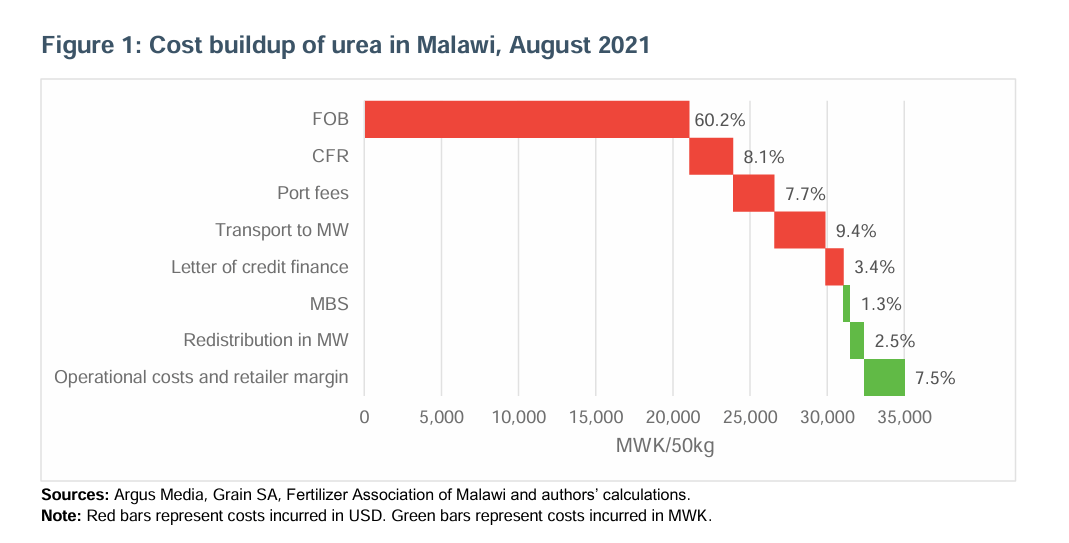
The graph shows that the cost of fertiliser in Malawi is influenced by a range of factors that are largely beyond the control of local suppliers or the government. As illustrated in the graph, the vast majority of the retail price – roughly 85 percent – is determined by external costs such as the free-on-board (FOB) price at the port of origin, international maritime freight and insurance (CFR), port fees, and the cost of transport to Malawi. The single most significant component is the FOB price, which alone accounts for 60.2 percent of the final price, followed by transport to Malawi at 9.4 percent, CFR at 8.1 percent, and port fees at 7.7 percent.
These externally determined expenses, combined with financing charges and currency depreciation, represent the primary drivers behind the sharp increase in fertilizer prices.
In contrast, internal costs like redistribution fees, Malawi Bureau of Standards (MBS) charges, and operational costs combined with retailer margins make up only a small fraction of the total price, with the latter accounting for just 7.5 percent. Consequently, transferring the supply responsibility entirely to parastatals like SFFRFM and ADMARC is unlikely to result in significantly lower consumer prices, as they face these same external cost constraints and would only be able to realize savings from a very small portion of the overall cost structure.
This is in relation to a bag of fertiliser in 2021 that was not subsidized.
So as you can see, if Malawi manufactured more of the raw materials for fertiliser within Malawi, it’s a certainty that such an industry would slash the cost of fertiliser significantly. Without the need for expensive government subsidies.
Thus, I think the Government of Malawi needs to take this issue seriously. Before shortages of fertiliser (precipitated by various factors like the conflict in Iran) begin to really bite. Below are some links that can help policy makers and entrepreneurs alike in this regard:
1. Ammonia Production Technologies : K.H.R. ROUWENHORST • P.M. KRZYWDA • N.E. BENES • G. MUL • L. LEFFERTS (Link here)

2. Ammonia Production Plant Design Project - By Alyeldin Helmy, Baihan Wang, Rajdeep Dev (Link here)

3. Small scale fertilizer production realized;a competitive and
sustainable business case - Authors: Joey Dobree, Stamicarbon (Link here)

4. A critical review on current urea removal technologies from water: An approach for pollution prevention and resource recovery. Dilieka Weerakoon,Bipan Bansal, Lokesh P. Padhye, Asaf Rachmani, L. James Wright, Gretel Silyn Roberts, Saeid Baroutian (Link here)

5. Green pathways for urea synthesis: A review from Australia's perspective. Dia Milani, Ali Kiani, Nawshad Haque, Sarabjit Giddey, Paul Feron (Link here)

6. Urea Production Cost Analysis Report 2026: Industry Trends, Plant Setup, Machinery, Raw Materials, Investment Opportunities, Cost and Revenue (Link here)

7. ‘This is not a hippy thing’: the startup recycling urine to make natural fertiliser. As recent conflicts expose vulnerability of fertiliser markets and its effect on food security, VunaNexus offers an alternative. By Chloé Farand (Link here)

8. Recovering nutrients from urine – A golden opportunity for sustainable fertiliser production. Hanxia Yu, Jason K. Reynolds, Veera Koskue, Serhiy Marchuk, Diogenes L. Antille, Bernadette K. McCabe, Cara D. Beal, Stefano Freguia, Niraj Yadav, Jeff R. Powell (Link here)

9. Advancing sustainable nutrient recycling and carbon neutrality: urea recovery and hydrolysis inhibition via a novel urea electro-forward osmosis system (UEFOS) from source-separated urine
Author links open overlay panel. Qiangqiang Jiao,Wenyu Gao, Chenkai Zhong, Zhewen Jiang, Biyue Xie, Zhenyu Yan, Junkai Wen, Jia Liu (Link here)

10. Continuous urea–nitrogen recycling from human urine: A step towards creating a human excreta based bio–economy. Prithvi Simha, A. Zabaniotou, M. Ganesapillai. (Link here)

11.Cheap electrochemistry process can turn urine into powdered fertiliser (Link here)

12. Small Scale Urea Production Plant Cost: 2026 Breakdown (Link here)

13. Green urea production for sustainable agriculture
Author links open overlay panel. Chengliang Mao, Jaewon Byun, Hamish W. MacLeod, Christos T. Maravelias, Geoffrey A. Ozin (Link here)
Citation: Duchoslav, Jan & Rusike, Joseph, 2021. “Why are fertilizer prices in Malawi high? And what can be done?,” MaSSP policy notes 42, International Food Policy Research Institute (IFPRI).

