
In a country where the electricity capacity generated is below what the country needs, this project is an interesting inspiration.
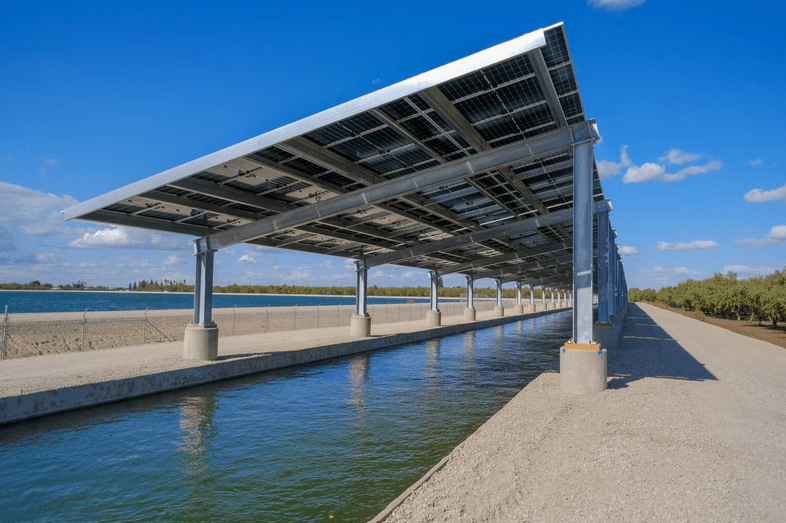
Solar Panels Over Canals: California’s Smart Experiment With Water and Energy
California has wrapped up a quiet but significant engineering experiment in its Central Valley. Project Nexus, a $20 million public-private pilot, involves installing solar panels directly above active irrigation canals. This was done in order to generate clean electricity while simultaneously reducing water loss from evaporation.
The logic is straightforward. The panels act as a shade canopy over the water, cutting evaporation losses by between 50 and 70 percent. Early data from one full irrigation season also shows an 85 percent drop in algae and weed growth inside the shaded canals, which could meaningfully reduce the cost of maintaining them(remember that solar panels need to be cleaned to maximise their generation capacity). Beneath the panels, the cooler water helps keep the solar arrays themselves running more efficiently in the heat. So its a symbiotic relationship of sorts.
A University of California, Merced study estimates that if panels were installed across all 4,000 miles of California’s open canal network, the state could generate 13 gigawatts of solar power and save 63 billion gallons of water annually. This is significant under any lens, especially considering the water shortages that have beset the state of California for several years now.
Project Nexus, currently producing 1.6 megawatts across two pilot sites, is the real-world test of that theory. And it’s a project that is worth closely monitoring.
Of course the approach is not without its challenges. Building structures strong enough to span moving water costs considerably more than standard ground-mounted solar, and maintenance crews must work carefully to avoid contaminating the water supply during cleaning. These cost pressures mean canal-top solar is unlikely to replace conventional solar farms altogether. Further, the assumption is that the canals pass trough accessible terrain – which may not be the case for another country looking to emulate this.
Still, this is an interesting project that pilots how water-stressed regions can extract double value from existing infrastructure – generating energy and conserving water from the same piece of ground, without disturbing farmland or natural habitats in the process. For countries managing scarce water resources alongside growing energy demand, it is a model worth watching.
Sources & Links:
- Solar panels built over California canals generate power, save water (American Society of Civil Engineers)
- Governor Newsom announces the completion of first-of-its-kind solar-covered canal in the Central Valley – piloting a new way to save water and reduce costs (GOV.CA)
- Consortium Looks to Expand Solar-Over-Canal Projects Statewide (UC MERCED)

