
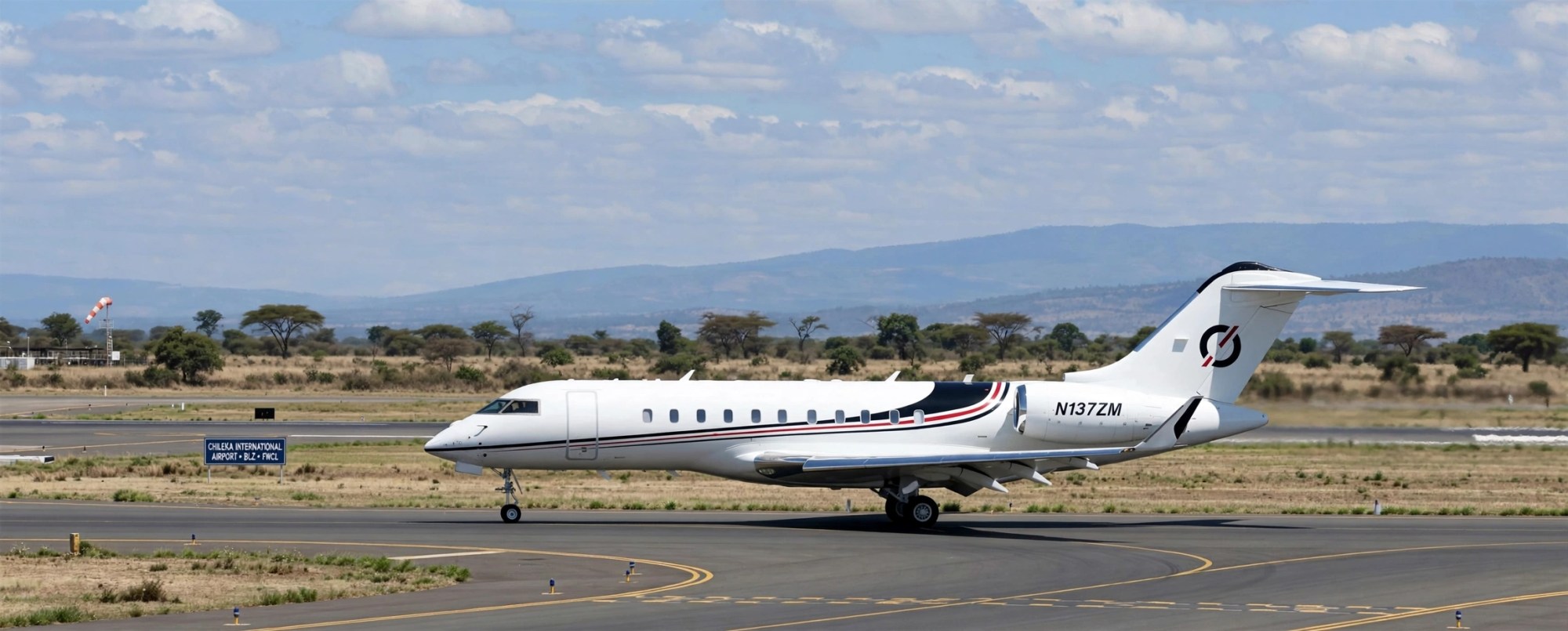
That is the real question left hanging after US pilot Terry Lee Jennings (some reports say Jennigson) was arrested on 5 August at Bakili Muluzi International Airport.
Jennings flew a Bombardier Global 5000 (N137ZM) from Lanseria Airport in South Africa, into Bakili Muluzi International Airport (formerly Chileka Airport) in Blantyre. Reports say the jet had been chartered to collect a foreign couple holidaying in Malawi. He was brought before Magistrate Paul Chiotcha, fined K3 million (about US$1,730), paid the fine, and the aircraft was allowed to leave, with reports saying it’s next destination was Portugal.
The aviation authorities in Malawi say the pilot failed to comply with aviation procedures. But strangely, they do not specify which ones?!
Foreign business and charter flights do not simply arrive at an airport out of nowhere. Malawi’s rules require prior landing or overflight permission and proper documentation for the aircraft, crew and operation. If the flight was commercial rather than purely private, extra licensing requirements apply. None of this is optional. So how did the aircraft get airborne from South Africa, presumably cross into Zimbabwean airspace, then cross into Mozambican airspace, then cross into Malawian airspace, receive landing clearance, and rolling to a stop before anyone noticed that there was a problem?!
Surely someone along the chain – flight planning, air traffic control, airport operations or the Civil Aviation Authority- should have seen the omission, and raised the issue?
Either the required authorisation was missing and went undetected, or some clearance was given and later judged inadequate. Either that, or we’re not being told something else here? And unfortunately the reporting in the public does not tell us what exactly happened.
That is not a minor administrative detail. It goes to whether Malawi’s aviation controls work before an aircraft lands or only after it is sitting on the apron.
And while the charging and issuing of fines looks straightforward. The unanswered questions are not:-
- Exactly which regulation was breached?
- What authorisation was missing or defective?
- Did the aircraft have a valid flight plan and landing clearance?
- Was this treated as a private flight or a commercial charter?
- Why was the problem only discovered after the jet had already landed?
Enforcing aviation rules is one thing. But doing so without explaining what actually went wrong, and how the system allowed it, is quite another. In my view the way this issue has been handled is not good enough. A modern international airport is supposed to catch these issues in the air, not on the ground.Because
Because think about it (and i know this example is extreme): what if one day an aircraft carrying an explosive (or worse : unsafe biological or chemical materials) flew into Malawian airspace and we didn’t know anything about it, where it was coming from, or other important details, and what if such an aircraft crash landed into one of our cities …?
Ayi ndithu anthu inu. Let’s get serious with these things please.

